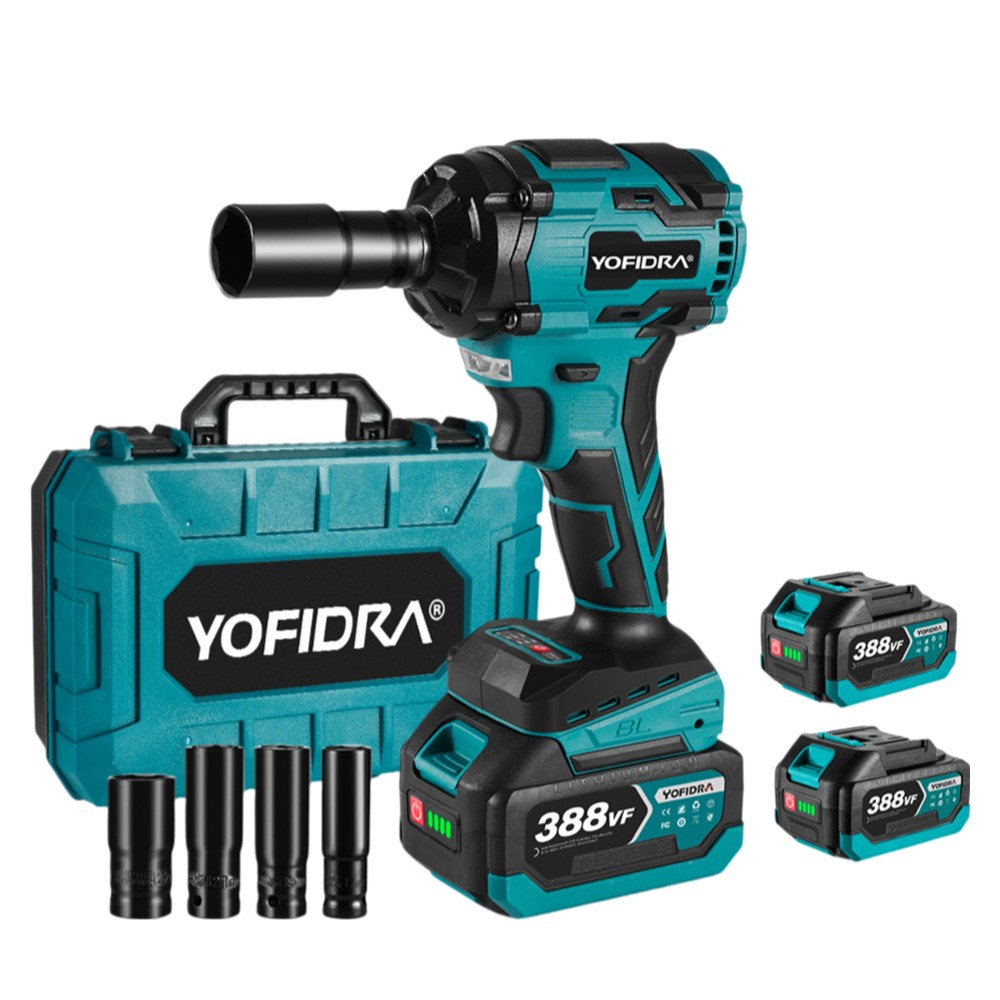
A brushless cordless impact wrench replaces carbon brushes with an electronic motor. This single change affects runtime, heat buildup, and torque delivery. Newbeny's impact wrench lineup uses this motor type for exactly these reasons. This guide breaks down brushless versus brushed motors and what the difference means on the job.
1. What Is a Brushless Cordless Impact Wrench?
A brushless cordless impact wrench is a battery-powered fastening tool that uses an electronic circuit board, rather than physical carbon brushes, to deliver electrical current to its motor. Older tools depend on carbon brushes that rub against a spinning commutator, and this contact creates friction, heat, and wear over time. A brushless motor removes that mechanical contact entirely.
Inside the motor, a permanent magnet sits on the rotor while electromagnets line the fixed stator. Sensors track the rotor's exact position, and the circuit board fires only the magnets needed to push it forward at that moment. Because power goes only where and when it is needed, the motor generates less waste heat. The result is a tool that runs cooler and pulls more work from a single battery charge than a brushed design.
This shift isn't just marketing talk, either. The global market for brushless power tools was valued at $13.4 billion in 2024 and is projected to reach $25.1 billion by 2030 (Grand View Research), and more than 69% of professional contractors in the U.S. now prefer cordless tools over corded ones (Fortune Business Insights). Brushless motors are a big part of why that switch has been possible.
2. How Does a Brushless Motor Work in a Cordless Impact Wrench?
To truly understand why tool companies made this switch, we need to look under the plastic housing. The difference between a brushed and a brushless motor comes down to how electricity travels from the battery pack to the spinning parts that turn your socket.
How a Brushed Motor Works in a Traditional Cordless Impact Wrench
For decades, almost every power tool used a brushed DC motor. It is a reliable, simple design, but it has some physical limitations. Here is what happens inside when you pull the trigger:
- Physical carbon brushes press against a rotating commutator to deliver electrical current. Think of the brushes as two small blocks of carbon. Springs push these carbon blocks firmly against a spinning copper cylinder called the commutator. The battery sends electricity through these carbon blocks directly into the spinning cylinder.
- Mechanical contact creates friction, heat, and spark arcing at the brush-commutator interface. Because the metal cylinder is spinning at thousands of revolutions per minute while the carbon blocks scrape against it, you get intense friction. If you look closely through the cooling vents of an impact wrench in a dark room, you will often see blue sparks flying inside. That is the electricity jumping the tiny gap as the parts scrape together.
- Every rotation loses energy to friction and electrical resistance at the contact point. All that scraping and sparking generates a lot of heat. Heat is just wasted battery power. According to industrial motor data from IBT Industrial Solutions, brushed motors usually operate at about 75 to 80 percent efficiency. The remaining 20 to 25% of your battery charge just turns into heat and noise before it ever reaches the lug nut.
How a Brushless Motor Works in a Modern Cordless Impact Wrench
Engineers solved the friction problem by turning the motor inside out and replacing mechanical parts with a computer chip.
- No physical brushes or commutator - electronic controller manages current delivery to the windings. Instead of using carbon blocks to deliver electricity to the spinning part, a brushless tool supplies power to the fixed outer ring (the stator). A tiny circuit board tracks exactly where the spinning center is at all times.
- The Rotor is a simple permanent magnet; the stator windings are fixed and controlled by the circuit board. The spinning center is just a heavy-duty permanent magnet. The stator, or outer casing of the motor, holds the copper wire coils. The electronic controller rapidly turns these outside coils on and off in a circle, creating a magnetic field that chases itself around the ring. The permanent magnet in the center simply chases that magnetic field.
- Power is delivered only where needed, at exactly the right time - no wasted energy. Because there is no physical contact between the electrical power source and the spinning rotor, there is zero friction. The circuit board calculates the exact amount of current needed for the load. If you are spinning a loose bolt, it uses very little power. If you hit a rusted lug nut, the computer instantly dumps maximum current into the magnets.
Why the Brushless Design Matters in a Cordless Impact Wrench
Understanding the mechanics is nice, but how does this help you in the garage? The lack of friction changes everything about how the tool performs.
- Eliminating friction means more battery energy reaches the output shaft. Because you are no longer wasting 25 percent of your battery heating up carbon blocks, efficiency jumps massively. Studies show brushless designs easily reach 85 to 90 percent efficiency. That means more work done per battery charge.
- No brushes to wear out - no gradual performance decline over time. Carbon brushes are like pencil lead. They literally grind away into black dust over time. As they wear down, the motor loses power and eventually dies. Brushless tools have nothing to wear out except the metal bearings holding the shaft.
- Electronic control allows precise torque and speed modulation at the circuit level. Because a computer chip manages the power, manufacturers can add smart features. This allows for precision modes, like auto-stop features that prevent you from overtightening a bolt or snapping a rusty screw.
Brushless Motor vs Brushed Motor in a Cordless Impact Wrench
To make things easy to compare, look at this breakdown of the core components and traits of both motor types.
|
Component |
Brushed Motor |
Brushless Motor |
|
Commutator and Brushes |
Uses physical carbon blocks pressing against a copper cylinder. |
None. Uses a circuit board and sensors to switch magnets on and off. |
|
Efficiency |
Lower (around 75-80%). Much of the battery energy is lost to friction. |
Very high (85-90%). Almost all battery power goes straight to turning the bolt. |
|
Heat Generation |
High. Friction from brushes makes the tool body hot during heavy use. |
Low. No friction means the tool stays much cooler during long jobs. |
|
Maintenance |
High. Brushes wear out over time and must be replaced to keep the tool working. |
Zero motor maintenance. No internal parts wear down from physical contact. |
|
Size and Weight |
Larger and heavier due to the space needed for the brush assembly. |
Much more compact and lighter, making it easier to fit into tight engine bays. |
|
Cost |
Cheaper to manufacture due to simple, older technology. |
Higher cost - requires an electronic control circuit and smart sensors. |
3. Is a Brushless Cordless Impact Wrench Better Than a Brushed One?
Yes, from a purely technical standpoint, a brushless impact wrench outperforms a brushed model in almost every category. The market reflects this reality heavily. According to a 2026 market research report by MarketIntelo, cordless impact wrenches now command nearly 40% of the entire global impact wrench market, and that massive growth is driven entirely by the advancement of battery and brushless motor technology. However, just because something is technically superior does not mean it is always necessary or financially justifiable for every user to spend the extra money on it.
To help you decide if a brushless impact wrench is better for your specific needs, let's look at a direct performance breakdown.
Direct Performance Comparison: Brushless vs Brushed Cordless Impact Wrench
|
Metric |
Brushed Cordless Impact Wrench |
Brushless Cordless Impact Wrench |
|
Torque Output |
Lower overall torque. Power maxes out earlier due to friction losses. |
High torque. The electronic controller pushes maximum power to the anvil. |
|
Battery Runtime |
Shorter. Wastes battery power creating heat and sparks. |
25-50% longer runtime on the exact same battery pack. |
|
Tool Lifespan |
|
|
|
Trigger Response |
Simple variable speed, but lacks smart control under load. |
Crisp and precise. Often features multiple electronic speed modes. |
|
Noise Level |
Louder. You hear the physical scratching of the brushes on copper. |
Quieter. Only the sound of the hammer mechanism is noticeable. |
|
Price Range |
Very affordable. Great for budget buyers. |
Premium pricing, but costs have dropped significantly in recent years. |
When a Brushless Cordless Impact Wrench Is the Better Choice
For certain people, spending the extra money upfront is non-negotiable. You may want to consider brushless models, especially if these criteria apply to you:
- l Professional or frequent use: If you frequently use an impact wrench daily, the time saved by reduced battery swaps could justify the investment in a brushless model.
- l Heavy-duty jobs requiring high torque: If you work on suspension parts, rusted farm equipment, or heavy machinery, you need maximum breakaway torque. Brushless motors deliver the highest peak torque numbers available today.
- l When you already own the tool platform: If you already own high-capacity batteries from a brand, upgrading to a bare-tool brushless wrench makes total financial sense.
When a Brushed Cordless Impact Wrench Is Good Enough
Do not let marketing make you feel bad for buying a brushed tool. They built houses and fixed cars for decades before brushless came along. A brushed tool is perfect for:
- Occasional home DIY use: If you only use an impact wrench twice a year to rotate the tires on your sedan, a brushed model will do the job perfectly well.
- First cordless impact wrench purchase: If you are on a tight budget and need the tool, a battery, and a charger all in one kit, brushed kits are much easier on the wallet.
- Low-torque jobs: If you are primarily driving lag bolts into wood or assembling metal racks, you may not need the full capacity of 1,000 foot-pounds of torque, but having some extra power can be beneficial.
The Value Calculation: Is a Brushless Cordless Impact Wrench Worth the Extra Cost?
When trying to figure out the value of a brushless impact wrench is, do a quick math exercise on longevity and battery life.
Let's say a brushed impact wrench kit costs $120, and the brushless version from the same brand costs $180. That is a $60 difference.
However, the brushless tool gives you roughly 30-50% more battery life. If you buy the brushed tool, you might have to spend $80 on a second battery just to get through a big weekend project without waiting for the charger. With the brushless tool, the single included battery might finish the whole job.
Furthermore, industrial motor expert Maxon Group points out that brushed motors hit their lifespan limit between 1,000 and 3,000 hours, whereas brushless motors easily reach tens of thousands of hours. If you plan to keep the tool for a decade, the brushless model is actually cheaper over time because you will never pay for replacement brushes or a replacement tool.
4. Key Benefits of a Brushless Cordless Impact Wrench
We know the parts are different, but how do those internal parts translate to real benefits in your garage? Let's break down the five major advantages of going brushless, keeping the older brushed models in mind as a baseline.
Benefit 1: Longer Battery Runtime in a Brushless Cordless Impact Wrench
When you pull the trigger on a brushed impact wrench, physical resistance fights the motor. Your battery has to push hard enough to overcome that internal scraping before it can even turn the socket. In a brushless cordless impact wrench, that resistance does not exist.
Real-world testing and industry data confirm that you will get 25 to 50 percent more runtime out of a brushless tool using the exact same battery. If your old brushed wrench could remove 40 rusted lug nuts on a 5.0Ah battery, a brushless wrench could easily handle 60 to 75 lug nuts before the battery indicator flashes red. This matters deeply if you are working outdoors or on a job site far away from a wall outlet.
Benefit 2: More Torque and Power in a Brushless Cordless Impact Wrench
A brushed motor has a hard ceiling on power. If the electrical load exceeds the design limits, it can cause carbon brushes to overheat, spark violently, and eventually melt or damage the commutator.
A brushless cordless impact wrench does not have this bottleneck. The electronic circuit board can safely dump massive amounts of power into the copper stator windings in milliseconds. This is why modern high-torque brushless impact wrenches can break loose bolts torqued to 1,400 foot-pounds. A brushed motor simply cannot handle that much electrical load without self-destructing.
Benefit 3: Longer Tool Lifespan in a Brushless Cordless Impact Wrench
Think about the brake pads on your car. Because they squeeze against the rotor to create friction, they eventually wear out and need replacing. A brushed motor operates on similar principles. The carbon brushes are designed to sacrifice themselves over time.
In a brushless cordless impact wrench, no brushes touch the rotor, eliminating brush friction. Because there is no physical contact, there is no wear and tear on the motor components. As industry data highlights, a brushless motor lasts 2 to 5 times longer under heavy professional use.
Benefit 4: Quieter Operation of a Brushless Cordless Impact Wrench
To be fair, an impact wrench is a loud tool by nature. The heavy metal hammer violently striking the anvil inside the housing creates a lot of noise. However, the motor itself should not add to that headache.
If you run a brushed tool with no load, you will hear a distinct mechanical whine and a scratchy, humming sound. That is the sound of the brushes scraping metal at thousands of RPMs. A brushless cordless impact wrench operates incredibly smoothly.
Benefit 5: More Compact and Lighter Design in a Brushless Cordless Impact Wrench
Carbon brushes, the springs that hold them, and the metal commutator take up physical space. Because engineers have to make room for all these wearing parts, brushed impact wrenches tend to be long and bulky.
By removing all of that hardware and replacing it with a flat circuit board, a brushless cordless impact wrench can be surprisingly small. Some modern brushless impact wrenches are designed to be more compact, often measuring around five to six inches in length.
5. Do All Major Tool Brands Make a Brushless Cordless Impact Wrench?
Yes. In fact, if you look at the professional tiers of any major tool company today, you will almost exclusively see brushless tools. The technology has matured to the point where it is the standard for anything above a basic entry-level kit. If you are wondering which brands have brushless motor options, the answer is virtually all of them. However, they all use their own marketing terms.
The Overview of Brushless Cordless Impact Wrench Options by Brand
Here is a quick look at the major players, the names they use for their brushless tech, and their typical platform specs.
|
Brand |
Brushless Series |
Top Torque |
Platform Compatibility |
|
Milwaukee |
FUEL |
1,200+ ft-lbs (M18) |
M18 and M12 battery systems |
|
DeWalt |
XR / ATOMIC |
1,200+ ft-lbs (20V Max) |
20V Max and FlexVolt batteries |
|
Makita |
LXT Brushless / XGT |
1,300+ ft-lbs (40V XGT) |
18V LXT or 40V XGT batteries |
|
Ryobi |
HP Brushless |
600+ ft-lbs (18V ONE+) |
18V ONE+ battery system |
|
Ridgid |
OCTANE / Brushless |
1,300+ ft-lbs (18V) |
Ridgid 18V battery system |
|
Metabo HPT |
Triple Hammer Brushless |
770+ ft-lbs (36V) |
MultiVolt or 18V batteries |
|
Newbeny |
Newbeny Brushless |
High-torque options |
Brand-specific high-capacity 20V/21V |
Choosing a Brushless Cordless Impact Wrench Based on Your Battery Platform
The biggest mistake you can make when buying a cordless impact wrench is ignoring the batteries you already own. Batteries are the most expensive part of cordless tools. Battery compatibility is the first factor to consider before purchasing a cordless impact wrench. Batteries account for a significant portion of the total cost of a cordless tool system, so the platform you already own should guide your next purchase. A user with an existing set of 20V batteries gains little by switching to a different brand, since that switch requires a new charger and a new battery set at additional cost.
For this reason, a bare tool from your current platform is generally the more practical choice. Buyers without an existing battery investment have more flexibility. In this case, a brushless option from a value-focused brand such as Newbeny is worth considering, alongside larger ecosystems built around a wider tool lineup.
6. How to Tell If Your Cordless Impact Wrench Is Brushless or Brushed
Sometimes you might inherit a tool from a friend, or you might be looking at a heavily used tool at a pawn shop or garage sale. If the sticker has worn off, it can be tricky to figure out what kind of motor is inside. Here is a simple checklist to determine exactly what you are holding.
Physical Signs That Your Cordless Impact Wrench Is Brushed
If you are inspecting an older tool, look and listen for these specific clues:
- l Audible brush noise: Pull the trigger slowly in a quiet room. You will hear a consistent humming, scratchy, or sparking sound during operation before the hammer mechanism even engages.
- l Visible carbon brushes on the tool body or inspection windows: Look at the back half of the tool near the cooling vents. On many brushed tools, you will see two round plastic caps on opposite sides of the motor housing. These caps allow you to unscrew and replace the carbon brushes.
- l Higher heat output during extended use compared to brushless models: If you run the tool hard for five minutes driving lag bolts, the plastic housing near the back of the tool will feel noticeably warm or even hot to the touch.
- l Gradual performance decline as the brushes wear down over time: If the tool feels significantly weaker today than it did two years ago, but the battery is fully charged, the brushes have likely worn down and are losing contact with the commutator.
Physical Signs That Your Cordless Impact Wrench Is Brushless
Modern tools are usually proud to announce their technology, but if the label is gone, look for these traits:
- No audible brush noise: When you pull the trigger, it runs noticeably quieter than brushed models. You hear an electrical whine and the fan, but no mechanical scraping.
- Cooler housing during extended use: Because less energy is wasted as heat, the plastic housing around the motor will stay relatively cool even after removing a whole set of tires.
- Most tools from 2018 onward are brushless - check the model year: If you look at the serial number plate and the tool was manufactured in the last five or six years, the chances are very high that it is a brushless model, especially if it is from a premium brand.
- Labeling mentions 'brushless,' 'electronically commutated,' or 'EC motor': Look very closely at the molded plastic. Even if the sticker is gone, many brands mold the word Brushless directly into the rubber or plastic handle. Some European brands use the term EC motor, which stands for Electronically Commutated.
7. Conclusion
While the older brushed designs still serve a purpose for absolute beginners or those on a very tight budget, the value proposition of brushless technology is simply too good to ignore. You get more work done, you charge your batteries less often, and you never have to worry about replacing tiny blocks of carbon. Whether you are cracking loose a stubborn axle nut with a heavy-duty model or driving hundreds of lag screws with a compact version, a brushless motor ensures that every drop of battery power goes directly to the job at hand.
8. FAQs
How Long Does a Brushless Cordless Impact Wrench Last Compared to a Brushed One?
A brushless cordless impact wrench typically lasts two to five times longer than a brushed model under the same working conditions. Because a brushed motor relies on physical carbon blocks that rub against metal, those blocks usually wear out between 1,000 and 3,000 hours of use.
Can You Use the Same Battery for a Brushless and a Brushed Cordless Impact Wrench?
Yes, provided the tools share the same brand and voltage platform. A given battery is designed to work across a manufacturer's tool lineup, so a standard 20V battery will typically power both an older brushed impact wrench and a newer brushless model from the same brand without issue.
Do All Brushless Cordless Impact Wrenches Have Auto-Stop?
No, not all of them do, but it is a very common feature. Because an electronic circuit board controls brushless motors, manufacturers can easily program smart features into the tool. Many mid- to high-tier brushless impact wrenches feature an auto-stop or "precision wrench" mode that senses when a bolt is loose and automatically stops the tool to prevent the nut from flying across the garage.
Can You Repair a Brushless Cordless Impact Wrench Motor?
Usually, you do not repair the motor itself; you replace the electronic components. With old brushed tools, you could pop in a $5 set of new carbon brushes to fix a dead tool. With a brushless tool, if the motor stops working, it usually means the electronic stator or the main circuit board has failed.
How Much Torque Does a Brushless Cordless Impact Wrench Typically Produce?
It varies widely by the size of the tool. A compact 3/8-inch drive brushless impact wrench might produce between 150 and 250 foot-pounds of torque, which is perfect for general automotive engine work. A mid-torque 1/2-inch drive model will typically push between 400 and 650 foot-pounds. The high-torque, heavy-duty brushless models from major brands can currently produce between 1,000 and over 1,400 foot-pounds of breakaway torque, easily rivaling large pneumatic air tools.