What size impact wrench for lug nuts do you need? Many people buy the wrong size impact wrench for their garage. They end up breaking a 3/8-inch tool on a rusted axle nut, or they damage small water pump bolts with a heavy 1/2-inch tool.
You can avoid these costly mistakes by matching the tool to the size of the fastener. Here is which size you need for your work:
- 1/4-inch: Built for interior trim and small engine work.
- 3/8-inch: Ideal for general repairs under the hood and brake jobs in tight spaces.
- 1/2-inch: The right choice for changing tires, heavy suspension work, and stuck lug nuts.
- 3/4-inch: Designed for commercial trucks, heavy machinery, and farm equipment.
1. What Is Drive Size in an Impact Wrench and Why Does It Matter?
Drive size is the amount of rotational force a tool can safely deliver to a fastener. For example, a larger square anvil can support greater mass, so it can withstand hammer blows without snapping.
How Drive Size Works in an Impact Wrench
The drive size refers to the physical dimensions of the square metal piece protruding from the front of the tool. You attach your sockets to this square peg. An internal motor spins a heavy metal hammer mechanism. This hammer strikes an anvil repeatedly, creating the "impact" action.
The square drive at the end of that anvil must absorb all that sudden, violent force. A thick piece of metal survives thousands of heavy strikes. A thin piece of metal twists and shears under the same load. Manufacturers build larger internal hammers for tools with larger drives. Therefore, a bigger drive directly equals a more powerful impact mechanism.
Why Drive Size Is Different From Socket Size in an Impact Wrench
Drive size and socket size measure two entirely different ends of the same piece of metal. The drive size measures the square hole at the back of the socket where it attaches to the tool. The socket size measures the hexagonal opening at the front that fits over your specific nut or bolt.
You can get a 15mm socket with a 1/4-inch, 3/8-inch, and 1/2-inch drive. The hex opening remains 15mm in all three scenarios. However, the back opening changes to fit different wrenches. For this reason, mechanics keep multiple socket sets in their toolboxes.
The Rule for Impact Wrench Drive Size
- The fundamental principle for selecting impact wrench drive sizes is to use a size that can deliver enough torque for your typical fasteners. The smallest drive size capable of reliably loosening or tightening your fasteners is usually the most efficient choice.
- Smaller fasteners or delicate work benefit from lower-impact, smaller-drive tools, while heavy-duty tasks such as suspension bolts or axle nuts require larger drive sizes with high torque capacity and heavy impacts for effective operation.
- Trying to force a small impact wrench to handle heavy fasteners by simply holding down the trigger longer is ineffective and can lead to overheating or damage. Always match the tool's capacity to the task for safety, efficiency, and durability.
2. 1/4 vs 3/8 vs 1/2 vs 3/4 Impact Wrench Drive Size Comparison
Every shop needs a specific tool layout to function properly. You will rarely find a single impact wrench that fixes everything. The physical dimensions of these tools dictate where you can reach and what you can break loose.
Comparison Table: All Impact Wrench Drive Sizes
|
Drive Size |
Torque Range |
Typical Jobs |
Socket Availability |
|
1/4" |
50 - 150 ft-lbs |
Interior trim, small engines, dash assemblies |
Excellent for 4mm to 14mm |
|
3/8" |
150 - 450 ft-lbs |
Brakes, engine bays, light suspension |
|
|
1/2" |
400 - 1,400 ft-lbs |
Lug nuts, heavy suspension, frame bolts |
Excellent for 10mm to 36mm |
|
3/4" |
1,000 - 2,000+ ft-lbs |
Commercial trucks, tractors, heavy plant equipment |
Excellent for 1-inch and larger |
What Is a 1/4-Inch Impact Wrench Best For?
The 1/4-inch impact wrench excels in delicate, restricted areas. These tools usually feature a hex-collet design rather than a square friction ring, making them impact drivers, though 1/4-inch square-drive wrenches also exist.
Small fasteners: electronics, appliances, consumer electronics
Small machine screws break very easily if you turn them too hard. A small quarter-inch tool gives gentle and fast taps. This helps you remove stuck screws from home machines, lawnmower parts, and electronic covers without damaging the screw threads.
Motorcycle maintenance where space is tight
Motorcycle frames are very tight for big tools. A quarter-inch wrench fits into tight spaces between the engine and covers. It works great for side bolts, battery screws, and handlebars.
Light assembly and precision mechanical work
Workers and hobbyists use the quarter-inch size to build workbenches, set up cabinets, and put together small machines. Because it is lightweight, your hands will not get tired even after long periods of use.
Where low torque is essential to avoid damaging delicate parts
Plastic parts and aluminium covers can bend or break if you screw them down too tightly. The low power of a quarter-inch tool keeps things safe. You will still need a special torque tool to finish tightening everything safely, but the small tool makes taking screws out and starting them much faster.
What Is a 3/8-Inch Impact Wrench Best For?
Most professionals reach for their 3/8-inch impact wrench more than any other tool in their cart. It offers the perfect balance between brute force and manoeuvrability.
Automotive maintenance: brake calipers, suspension components, transmission bolts
This tool is the go-to choice for everyday car repairs. It handles tight brake caliper bolts, transmission components, and mid-sized suspension parts where a larger 1/2-inch tool is too bulky and a 1/4-inch tool lacks the necessary power.
Compact car tire changes (with sufficient torque rating)
Modern high-torque 3/8-inch wrenches put out incredible power. A premium battery-powered unit can deliver upwards of 400 ft-lbs of breakaway torque. That easily handles the 80 ft-lbs required for a Honda Civic or Toyota Corolla wheel, assuming the nuts are not completely seized by winter road salt.
The most versatile drive size for general automotive work
If you pop the hood on a modern vehicle, almost every bolt you see falls into the 10mm to 18mm range. The 3/8-inch drive covers this range perfectly. It provides enough punch to handle rusty exhaust clamps but remains light enough that your wrist won't ache after an eight-hour shift.
What Is a 1/2-Inch Impact Wrench Best For?
When someone asks what size impact wrench is best for serious car teardowns, the answer is always the 1/2-inch drive. This is the heavy hitter of the standard garage.
Vehicle tire changes on any car, truck, or SUV
A 1/2-inch tool is highly effective for removing wheel nuts, significantly reducing the effort required compared to manual tools. Whether you are dealing with a standard sedan or a heavy-duty pickup truck, the high torque of a 1/2-inch impact wrench breaks loose rusted nuts and bolts effectively. It takes the physical strain out of seasonal tire rotations.
Heavy suspension and engine work requiring high torque
Control arm bolts, subframe connectors, and axle nuts require massive breakaway force. Factory assembly lines often tighten axle nuts to over 200 ft-lbs, and years of road grime bake them into place. A 3/8-inch tool will rattle uselessly against an axle nut. A 1/2-inch tool hits hard enough to shock the threads loose.
Agricultural equipment and medium-duty commercial applications
This size handles the heavy demands of farm equipment and medium-duty commercial vehicles. It easily removes rusted bolts on tractor decks, implement blades, trailer hitches, and delivery truck suspension parts where smaller tools simply fail to break them loose.
What Is a 3/4-Inch Impact Wrench Best For?
The 3/4-inch impact wrench is designed for severe, high-torque industrial and commercial applications. This heavy-duty tool handles massive fasteners on semi-truck suspension systems, large construction machinery, heavy-duty agricultural tractors, and industrial plant equipment.
Commercial trucking and heavy equipment maintenance
Eighteen-wheelers and dump trucks utilise massive lug nuts tightened to 450 ft-lbs or more. You cannot remove these with standard passenger car tools. The 3/4-inch wrench delivers the terrifying breakaway torque needed for commercial fleet maintenance.
Large industrial fasteners beyond the reach of 1/2-inch tools
Industrial pipeline flanges, bridge assembly bolts, and heavy manufacturing presses rely on massive hardware. A 3/4-inch tool provides the necessary shock value to overcome industrial-grade thread locker and decades of structural rust.
Professional use where maximum torque is required daily
Heavy diesel mechanics use these tools constantly. The internal components of a 3/4-inch gun are built to withstand continuous, violent operation without suffering from metal fatigue or heat failure.
3. What Size Impact Wrench Do You Need for Lug Nuts?
For 90% of passenger vehicles and light trucks, you need a 1/2-inch impact wrench to remove lug nuts reliably. While smaller tools might work on a brand-new car in perfect weather, real-world conditions demand the power of a half-inch drive.
Recommended Impact Wrench Drive Size by Vehicle Type
|
Vehicle Type |
Lug Nut Torque |
Recommended Drive Size |
Notes |
|
Compact car (Civic, Corolla) |
70 - 80 ft-lbs |
3/8" or 1/2" |
3/8" works well unless severely rusted. |
|
Midsize sedan (Camry, Accord) |
75 - 90 ft-lbs |
1/2" |
1/2" prevents tool strain. |
|
SUV / Crossover (RAV4, CR-V) |
80 - 100 ft-lbs |
1/2" |
Highly recommended for ease of use. |
|
Full-size truck / SUV (F-150) |
130 - 150 ft-lbs |
1/2" |
Mandatory. 3/8" will struggle and fail. |
|
Heavy-duty truck (F-250, 2500) |
150 - 165 ft-lbs |
1/2" High-Torque |
Requires a premium, high-output 1/2" tool. |
|
Motorcycle |
Varies widely |
3/8" |
Axle nuts may require 1/2", but most work takes 3/8". |
Can a 3/8-Inch Impact Wrench Remove Lug Nuts?
Many people wonder: can a 3/8 impact wrench remove lug nuts? The honest answer depends on the specific tool model and the vehicle's condition.
A premium, modern brushless 3/8-inch battery impact can produce enough breakaway force to remove lug nuts from a Honda Civic or a Mazda 3. If a shop installed those wheels properly with a calibrated torque wrench to 80 ft-lbs, the 3/8 tool will handle it.
In the real world, tire shops sometimes use powerful air guns to tighten wheels way too much. During winter, water gets inside the threads and makes them rusty. Also, heat from heavy braking bakes the nuts tightly onto the aluminium wheels. In these hard situations, you might need a lot of power—up to 250 foot-pounds—to loosen the nut. A standard three-eighths-inch tool will get too hot, stop working, and fail to move the nut.
The 1/2-Inch Impact Wrench: The Standard for Lug Nut Work
If you find yourself asking what size impact wrench do I need for seasonal tire swaps, look no further than the 1/2-inch drive. It possesses the anvil mass and hammer weight to shock rusty, seized threads loose.
Mechanical best practices call for a strict separation of duties with wheels. Use the high-torque 1/2-inch impact wrench only to remove them. It strips the nuts off the studs in seconds. When you put the wheel back on, thread the nuts by hand. You may use the impact on its lowest setting to snug them against the rim.
When a 3/4-Inch Impact Wrench Is Required for Lug Nuts?
You cross into 3/4-inch territory when you leave passenger vehicles behind. Box trucks, commercial delivery vans, city buses, and heavy farm tractors require this massive tool.
The lug nuts on a Ford F-450 dually or a Freightliner truck laugh at half-inch tools. The nuts are massive, the studs are incredibly thick, and the torque specifications exceed 400 ft-lbs just for standard fastening. Breaking those loose requires a 3/4-inch or even a 1-inch drive pneumatic gun attached to a high-volume shop air compressor.
4. What Size Impact Wrench Do You Need for Automotive Work?
Automotive repair requires reaching into confined spaces just as often as it requires breaking heavy bolts.
Best Impact Wrench Drive Size for Common Automotive Jobs
|
Job Type |
Best Drive Size |
Min Torque Needed |
Recommendation |
|
Tire changes - passenger vehicles |
1/2" |
250 ft-lbs breakaway |
Standard 1/2" mid-torque model. |
|
Tire changes - heavy trucks |
3/4" |
1,000 ft-lbs breakaway |
Heavy-duty pneumatic or 18V high-torque. |
|
Suspension work (struts, arms) |
1/2" |
300+ ft-lbs breakaway |
Rust is your enemy here; go big. |
|
Engine / cylinder head bolts |
3/8" or 1/2" |
100 ft-lbs |
1/2" for removal, manual torque for install. |
|
Transmission pan / valve cover |
1/4" or 3/8" |
15 ft-lbs |
Low power prevents cracked aluminium. |
|
Brake caliper bolts |
3/8" |
80 ft-lbs |
Perfect size for the wheel well space. |
|
Differential cover / axle bolts |
3/8" |
60 ft-lbs |
Compact head fits around suspension bits. |
Suspension and Chassis Work With an Impact Wrench
Suspension work represents the harshest environment for an automotive mechanic. Lower control arm bolts live inches from the pavement. They soak up water, road salt, mud, and intense heat for years. Rust chemically bonds the steel bolt to the steel sleeve inside the rubber bushing.
You need a 1/2-inch impact wrench for this work. A smaller tool simply bounces off the bolt head. The heavy anvil of a half-inch tool transfers deep, concussive shocks through the bolt shaft, shattering the rust bond. Strut tower bolts, tie rod ends, and subframe mounts all require the high-impact torque only a 1/2-inch drive can deliver.
Engine and Drivetrain Work With an Impact Wrench
Engine bay work completely changes the physical requirements. Once you open the hood, space vanishes. Cooling fans, radiator hoses, exhaust manifolds, and wiring harnesses block your hands.
A 3/8-inch impact shines brightly here. It features a shorter head profile. You can slide it down between the radiator and the serpentine belt to remove a water pump pulley. You can reach the top bell-housing bolts behind the intake manifold.
Furthermore, engine blocks consist of cast aluminium or thin iron. Fasteners that thread into these materials can easily strip. The limited torque of a 3/8-inch tool prevents you from accidentally tearing the threads out of an aluminium cylinder head during teardown.
Brake System Work With an Impact Wrench
Brake systems combine tight clearances with moderate torque requirements. The primary fasteners are the caliper slide pins and the main caliper bracket bolts.
The 3/8-inch drive is the best tool for brake jobs. A 1/2-inch gun usually won't fit between the caliper and the inner fender liner, forcing you to use hand tools. The 3/8-inch tool slips right into that gap. It packs enough punch to break loose bracket bolts covered in factory thread-locker, saving you immense time during a standard four-wheel pad and rotor replacement.
5. Can You Use the Same Impact Wrench Drive Size for Everything?
Just as you wouldn’t rely on a single type of hammer to perform all construction tasks, you cannot rely on one impact wrench size for all automotive repairs. Trying to force one tool to do everything leads to broken bolts or broken tools.
The Versatility Trade-Off Between Impact Wrench Drive Sizes
A 1/2-inch impact wrench handles most jobs but is overkill for small fasteners
If you pull the trigger on a half-inch gun while attached to a 10mm bolt holding a plastic splash shield, the bolt will shear off instantly. You lose all tactile feedback. The extreme power turns minor tasks into drilling and tapping nightmares.
A 3/8-inch impact wrench is versatile but may lack power for heavy lug nuts
You will love the 3/8-inch size for 80% of the car. But the moment you hit a rusted axle nut or try to rotate tires on an old Ford F-150, the tool will chatter without turning the nut. You will end up grabbing a massive breaker bar anyway.
Most professionals own at least 3/8-inch and 1/2-inch impact wrenches
Real-world mechanics buy both. They keep the 1/2-inch gun on the bottom shelf of the cart for wheels and suspension. They keep the 3/8-inch gun on the top shelf for brakes, interior work, and engine bays. It represents a necessary dual-investment.
Adapters: Using a Smaller or Larger Socket on Your Impact Wrench
If you have a 3/8-inch tool but need to turn a massive 24mm nut, you can attach an adapter that features a 3/8 hole on the back and a 1/2-inch square on the front. This lets you attach heavy sockets to your small tool.
A 1/2-inch impact wrench can use 3/8-inch sockets with a reducer adapter
Conversely, if you only own a 1/2-inch gun, you can attach an adapter that reduces the drive size, letting you use smaller 3/8-inch sockets to reach tighter spots.
You must understand the physics of shear strength. The tool generates twisting force. The adapter acts as a weak middleman. If you put a heavy 1/2-inch socket on a small 3/8-inch tool and try to break a rusty bolt, the tool will twist the adapter.
Impact Wrench Adapter Safety Rules
Adapters break constantly in professional shops. According to shop safety guidelines and material failure limits, an adapter's square drive is a major weak point.
When you adapt a massive 1/2-inch gun down to a tiny 3/8-inch socket, the gun creates more torque than the narrow neck of the adapter can physically handle. If the bolt refuses to turn, the adapter absorbs the shock. It will violently snap in half.
6. Is a 3/8-Inch or 1/2-Inch Impact Wrench Better for You?
If you can only afford one tool today, you need to evaluate your weekend plans carefully.
Choose a 3/8-Inch Impact Wrench If...
Your primary work is automotive maintenance (not tire-focused)
If you spend your time doing oil changes, replacing alternators, swapping water pumps, and doing brake jobs, this size wins.
You need a lighter, more compact tool for tight spaces
Working under a car on jack stands provides very little clearance. A compact 3/8-inch tool lets you swing your arms and manoeuvre the tool without banging into the exhaust pipe.
Budget is a constraint - 3/8-inch models are typically less expensive
Smaller motors and smaller anvils cost less to manufacture. You also save money because 3/8-inch socket sets generally cost less than massive half-inch sets.
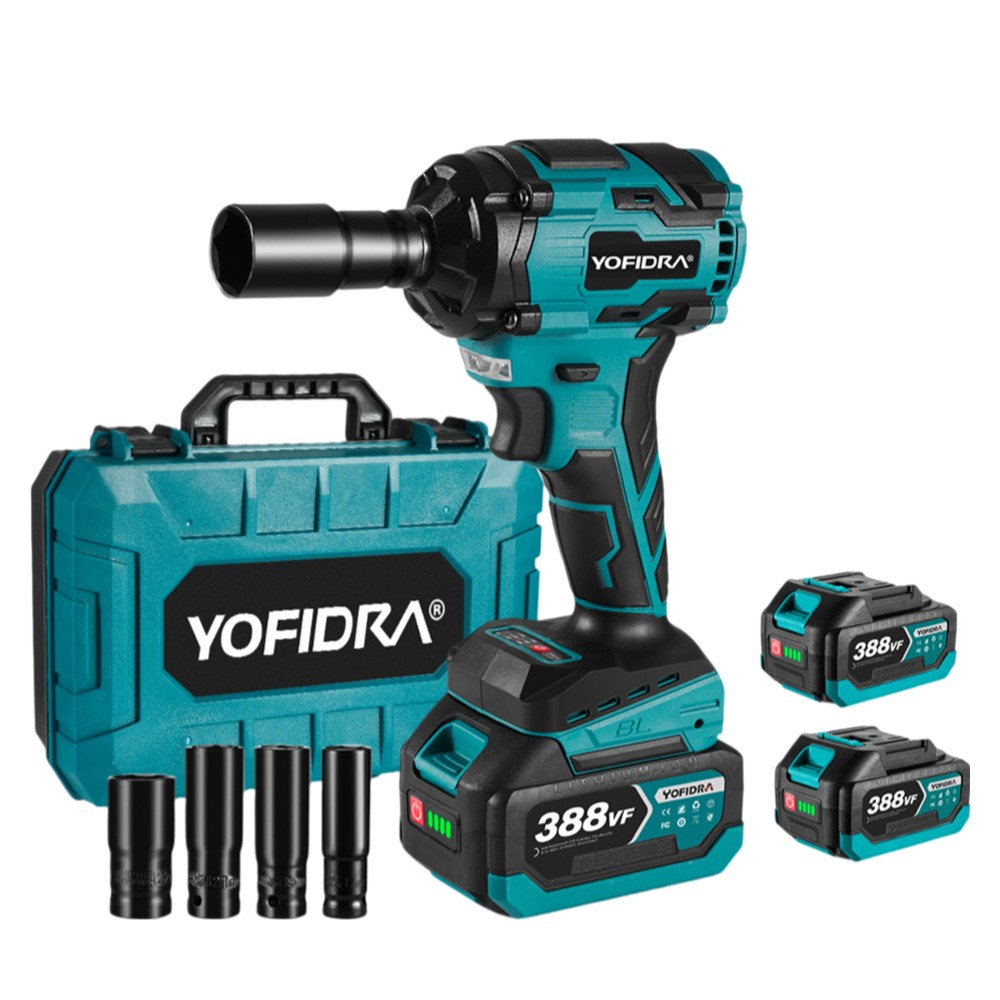
If you want a reliable impact wrench for your garage without paying tool-truck prices, the Newbeny Impact Wrench is a good budget-friendly choice. It gives DIYers the strong brushless power they need without costing a lot of money.
Most of your jobs involve fasteners under 400 ft-lb
Modern 3/8 tools easily break the 300 ft-lb barrier. That covers almost every standard bolt on a passenger sedan aside from the hub assemblies.
Choose a 1/2-Inch Impact Wrench If...
Tire changes are your main use case (most common scenario)
If your sole goal is swapping winter tires in your driveway twice a year, buy the 1/2-inch model. It turns a sweaty, back-breaking hour into a ten-minute breeze.
You work on trucks, SUVs, or any vehicle with higher torque specs
Trucks feature heavy, thick steel components. The hardware matches the frame. A smaller tool will leave you stranded when you try to change a truck strut.
You want one tool that handles the widest range of jobs confidently
You can always dial down the power on a 1/2-inch wrench using the speed selector buttons. You cannot magically add power to a 3/8-inch tool. The bigger tool gives you headroom.
You value having maximum power headroom for stubborn fasteners
Nothing feels worse than buying a power tool that fails to remove the very first bolt you try it on. A mid-torque or high-torque half-inch tool virtually guarantees that the bolt will come out.
7. Conclusions
Choosing the right drive size hinges on selecting a tool that fits the torque requirements of your specific automotive tasks. Buy a 1/2-inch impact wrench if you plan to rotate tires and rebuild suspensions on trucks and SUVs. Buy a 3/8-inch impact wrench if you want to perform detailed engine bay repairs, brake jobs, and general maintenance on standard passenger cars.
8. FAQs
Do Drive Size and Torque Rating Mean the Same Thing?
No. Drive size measures the physical dimensions of the square metal anvil (1/4", 3/8", 1/2"). Torque rating measures the rotational twisting force the tool produces. However, larger drive sizes allow engineers to build internal mechanisms that generate much higher torque ratings.
What Is the Most Common Impact Wrench Drive Size?
The 1/2-inch drive is the most common impact wrench size for home garages and tire shops because it perfectly fits standard automotive lug nuts. The 3/8-inch drive serves as the most common size for line mechanics doing under-hood repairs.
Can You Use an Impact Wrench Adapter to Step Up Drive Size?
You can use a step-up adapter, but you risk breaking it under heavy loads. An adapter creates a mechanical weak point. If you put a heavy 1/2-inch socket on a small 3/8-inch tool to tackle a stubborn bolt, the sheer force will often snap the adapter shaft in half.
What Size Impact Wrench Do Professionals Use?
Professional automotive mechanics use both 3/8-inch and 1/2-inch impact wrenches daily. They use the 1/2-inch for heavy wheels and chassis components, and immediately switch to the 3/8-inch for tighter clearances around brakes, transmissions, and engine blocks. Heavy diesel mechanics move up to 3/4-inch tools.
If you work on cars at home, the Newbeny impact wrench is a good daily option. It has enough power to change tires and fix suspension parts, and it costs much less than big brand-name tools.