Tightening bolts requires the correct amount of force. For example, car lug nuts usually need 80–120 Nm. However, large truck bolts require much more, between 400 and 800 Nm. If you use the wrong torque, you will strip the threads, break parts, or find that your tool is not strong enough for the task.
This guide explains everything about impact wrench torque. We will cover:
1: How much power do you actually need?
2: What the technical numbers represent
3: Best ways to set and verify your tools.
1. Understanding Impact Wrench Torque
What Is Torque on an Impact Wrench?
Torque is the twisting power of a wrench. It measures how hard the tool turns a bolt. For example, high torque helps you move big or stuck fasteners.
Initially, an impact wrench might look like a standard drill. However, it works differently from regular tools because it does not turn with steady pressure. Instead, an internal hammer hits the tool many times per second. As a result, these fast, sharp hits create bursts of power. So ultimately, these sudden hits allow an impact wrench to loosen rusted bolts that a standard ratchet cannot budge, even if the torque ratings look equal.
Two torque numbers matter:
- Maximum torque
- Fastening torque
The peak force the tool can produce for a fraction of a second. Used to break stuck fasteners loose.
First, you must understand fastening torque. This is the power the tool uses when tightening a bolt. Typically, this value is only 50–70% of the maximum torque listed on the box.
Generally, manufacturers frequently use breakaway torque for marketing purposes. For instance, if your tool is labeled as a 300 Nm impact wrench, that number shows its loosening power. However, the tool will not tighten bolts to 300 Nm. In reality, it will fasten bolts to a range of 150–210 Nm.
Understanding Torque Units and Their Conversions
Two units appear most often on impact wrench specs:
Unit |
Full Name |
Common Use |
Nm |
Newton-meter |
Europe, Asia, most global manufacturers |
ft-lb |
Foot-pound |
USA, North America |
in-lb |
Inch-pound |
Small tools, light-duty electronics, and bicycles |
Quick conversion:
- 1 ft · lb = 1.356 Nm
- 1 Nm = 0.737 ft · lb
- 100 Nm ≈ 74 ft · lb
- 300 Nm ≈ 221 ft · lb
- 400 Nm ≈ 295 ft · lb
When reading bolt torque specs in ft-lb and your wrench is rated in Nm, multiply ft-lb by 1.356 to convert.
Torque Differences Between Pneumatic, Cordless, and Corded Impact Wrenches
Power Source |
Torque Range |
Typical Applications |
Pneumatic (Air) |
300 – 1,500+ Nm |
Heavy truck maintenance, industrial shop use |
Cordless (Battery) |
100 – 1,500 Nm |
General automotive, mobile repairs, job site work |
Corded (Electric) |
200 – 1,000+ Nm |
Heavy-duty tire changes, shop-based assembly, DIY garage work |
Pneumatic tools typically deliver the highest torque output compared to cordless and corded electric tools. They need an air compressor and hose, but produce consistent, powerful output without battery concerns.
Cordless tools have improved dramatically. High-end 20V and brushless models now reach 1,200–1,500 Nm. They trade some raw power for freedom of movement.
Corded electric tools sit between the two. No compressor needed, no battery to charge. Power output is steady but limited by motor size.
2. How Much Torque Do I Need for an Impact Wrench for Different Applications?
How Much Torque for Lug Nuts
Lug nut torque specs differ by vehicle type:
Vehicle Type |
Lug Nut Torque Needed |
Recommended Wrench Capacity |
Compact Car |
80–130 Nm |
200–300 Nm wrench |
Full-size Sedan/SUV |
100–160 Nm |
300–400 Nm wrench |
Light Truck / Pickup |
130–200 Nm |
400–500 Nm wrench |
Heavy-Duty Truck |
400–600 Nm |
700–1,000 Nm wrench |
You will need a wrench rated higher than the fastener specification. A 300 Nm wrench running at full power on a 130 Nm lug nut risks overtightening. Use torque settings or a torque stick to regulate torque.
Torque sticks are color-coded bars that flex at a set torque. They are a simple, cheap way to prevent overtightening lug nuts with an impact wrench.
How Much Torque for Automotive Repairs
Different parts of a vehicle need different torque levels:
Job |
Torque Range |
Notes |
Lug Nuts |
80–200 Nm |
Varies by vehicle size and wheel type |
Brake Caliper Bolts |
25–80 Nm |
Precision is key; use lower torque settings |
Oil Drain Plug |
20–40 Nm |
Easy to strip; use low setting or hand-tighten |
Wheel Bearing Hub Nut |
150–280 Nm |
High-tension area; always check OEM specs |
Engine Mounting Bolts |
50–120 Nm |
Follow OEM specifications closely for safety |
Suspension Components |
80–300 Nm |
Varies widely depending on the specific part |
For most passenger car work, a 300–400 Nm cordless or pneumatic impact wrench handles nearly every job. For removing seized bolts, a 500–600 Nm tool gives extra breakaway power.
How Much Torque for Heavy Machinery and Industrial Fasteners
Heavy equipment, agricultural machinery, and industrial assembly require significantly more torque:
Application |
Torque Range |
Semi-truck Lug Nuts |
400–700 Nm |
Heavy Equipment Track Bolts |
500–1,200 Nm |
Industrial Flange Bolts |
300–1,500+ Nm |
Large Structural Bolts |
600–2,000+ Nm |
For this category, a high-torque impact wrench rated 1,000 Nm or above is the correct tool. Most standard cordless impact wrenches are not built for sustained heavy industrial use. Pneumatic or large corded tools are more reliable here.
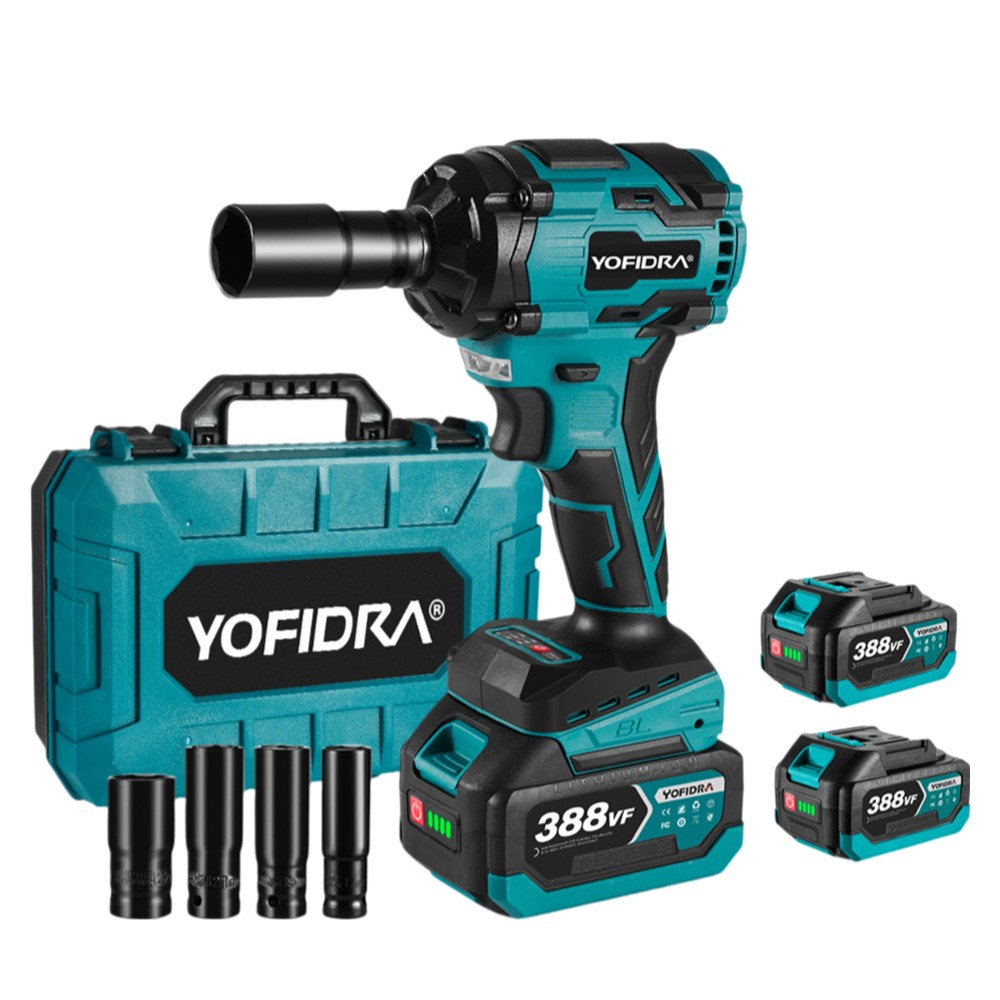
The NewBeny 1/2" cordless wrench handles everything from small cars to heavy trucks. With 1,200 Nm of torque, it works for every vehicle in this table. It is strong enough to remove even the most rusted or stuck bolts. Use this one tool for any heavy-duty job.
How Much Torque for Household and Outdoor Equipment
Light DIY tasks and outdoor power equipment need far less torque:
Task |
Torque Needed |
Lawn Mower Blade Bolt |
40–60 Nm |
Deck Screws / Lag Bolts |
10–60 Nm |
Fence Post Hardware |
30–80 Nm |
Riding Mower Wheel Bolts |
50–80 Nm |
HVAC Mounting Hardware |
15–40 Nm |
A 100–200 Nm compact or mid-size cordless impact wrench can effectively handle light-duty tasks such as household repairs and maintenance. For household work, the risk is usually overtightening, not undertightening.
How Much Torque for Electrical and Electronics Assembly
Electrical panels, junction boxes, and light electronics use very small fasteners that require minimal torque:
Task |
Torque Needed |
Electrical Panel Screws |
1–5 Nm |
Switch Plate Hardware |
0.5–2 Nm |
Small Electronics |
0.2–1 Nm |
A standard impact wrench is the wrong tool here. Use a precision electric screwdriver with adjustable torque. The lowest setting on most impact wrenches (20–50 Nm) is still far too high for delicate electronics.
3. How to Set Torque on Different Types of Impact Wrenches
Identify Your Impact Wrench Type
Before adjusting torque, confirm which type of tool you have:
- Pneumatic (air-powered) Impact Wrench
- Cordless (battery-powered) Impact Wrench
- Corded (electric) Impact Wrench
Has an air inlet fitting. Specifically, it connects to a compressor hose
Has a removable battery pack. Moreover, it has no cord or hose.
Has a power cord. Consequently, it has no battery and no air hose. Importantly, each type adjusts torque differently.
Do All Impact Wrenches Have Torque Settings?
No. Many basic and mid-range impact wrenches have no torque adjustment at all. Instead, they run at full power every time.
Tools that do have torque settings generally offer one of these:
- Speed/power modes
- Variable trigger
- Electronic torque control
- Pneumatic flow control
Labeled as Low / Medium / High, or Mode 1 / 2 / 3. Basically, lower speed equals lower torque output.
Squeezing the trigger partway lowers speed. However, this method is imprecise.
Found on premium tools. Here, a dial or digital setting controls the maximum output precisely.
A regulator valve on air tools controls air pressure. As a result, this directly affects torque.
Furthermore, if your tool has no adjustment mechanism, you must use torque sticks or a separate torque wrench to finalize tightening.
Understand the Manufacturer's Torque Adjustment Mechanism
Always read your tool's manual before guessing. Commonly, adjustment mechanisms include:
- Side dial or ring: Rotate the housing to select a power level.
- Button on the back or top: Cycles through modes with each press. Usually, an LED display shows the current mode.
- Regulator on the air inlet: Screw it in or out to change the air flow on pneumatic tools.
- App-connected control: Some advanced tools now feature Bluetooth connectivity, allowing for precise torque programming through a smartphone app.
Ultimately, always consult the user manual for your specific tool model before making assumptions about its features and settings. What works on a Milwaukee is different from a Makita or an Ingersoll Rand.
4. How to Set Torque on Different Impact Wrench Types
How to Set Torque on a Cordless Impact Wrench — Step by Step
- Remove the battery
- Locate the mode selector.
- Press or turn to select your desired mode
- Verify the indicator
- Test on a scrap bolt first
- Final Precision
Remove the battery before making any adjustments if the tool is not in use. For active adjustment, keep the battery in.
This is usually a button near the top of the tool, or a rotating collar behind the chuck.
Mode 1 is the lowest torque; the highest mode number delivers maximum torque. Check your manual for Nm values per mode.
Most tools show the selected mode on an LED strip or small display.
Run the wrench on a known fastener and check the result with a torque wrench to confirm output.
For final precision, use the impact wrench to seat the bolt, then finish with a calibrated torque wrench to reach the exact spec.
How to Set Torque on a Corded Electric Impact Wrench: Step by Step
- Unplug the tool
- Find the variable speed dial or switch.
- Set the dial to the appropriate level.
- Plug the tool back in.
- Make a test run.
- Adjust up or down
Unplug the tool before adjusting any settings.
On most corded models, this is a wheel near the trigger or a multi-position switch on the body.
Lower numbers = lower torque. Higher numbers = full power.
Apply the tool to a similar fastener and check tightness with a torque wrench.
Based on the result, adjust up or down.
Some corded tools have only an on/off trigger with partial-squeeze speed control. In that case, the trigger itself is your only adjustment — squeeze lightly for lower torque output.
How to Set Torque on an Air Impact Wrench — Step by Step
- Check your compressor pressure.
- Locate the regulator valve.
- Turn the regulator counterclockwise.
- Set the forward/reverse selector.
- Test on a similar fastener.
- Adjust compressor output.
Most pneumatic impact wrenches work between 90 and 100 PSI. Running lower pressure reduces torque; exceeding maximum PSI can damage the tool.
On the tool's air inlet (not all tools have one — some rely entirely on compressor pressure).
It will reduce air flow, which reduces torque. Turn clockwise to increase.
Set forward/reverse selector. Forward for tightening, reverse for loosening.
Use a torque wrench afterward to confirm the actual applied torque.
Adjust the compressor output if the tool lacks its own regulator. Lower the compressor's output pressure setting by 10–15 PSI increments until you reach the desired torque range.
Note: Air impact wrenches are the hardest to set to a precise torque value. For precision work, always follow up with a calibrated torque wrench. In repetitive tasks, such as working with lug nuts, using a torque stick—a tool designed to limit torque applied—can be the most practical solution.
Tips for Accurate Torque Setting
- Always check the OEM torque spec for the fastener you are working on. Do not guess.
- Use a torque wrench to verify after using an impact wrench, especially for critical bolts (wheel, suspension, engine).
- Never rely on impact wrench modes alone for safety-critical fasteners. The modes are approximate, not calibrated.
- Cold vs. warm conditions matter. Impact wrench output can vary slightly in cold temperatures, especially for cordless tools with lithium-ion batteries.
- Wear on the anvil and socket can reduce effective torque. Inspect for worn square drives and cracked sockets.
- Use impact-rated sockets only. Standard chrome sockets can shatter under impact wrench use.
5. Safety Considerations During Torque Adjustment and Use
- Never exceed the fastener's torque spec.
- Wear eye protection.
- Secure the workpiece.
- Check air hose connections.
- Do not use impact wrenches on precision torque-sensitive bolts.
- Keep the tool away from flammable materials.
Over-torquing strips threads and can cause bolt failure under load — especially dangerous on wheel and brake components.
Impact wrenches can eject broken sockets or debris at high speed.
Do not hold parts by hand while applying high torque.
Check air hose connections before use on pneumatic tools. A loose hose under pressure is a serious hazard.
Avoid using impact wrenches on precision torque-sensitive bolts without a proper torque wrench for final tightening.
Due to the heat and sparks generated during heavy use, always keep the tool away from flammable materials.
6. Conclusion
Picking the right tool is mostly about matching the power to your specific job. If you’re just swapping tires on a small car, a basic 300–400 Nm wrench is enough, but heavy trucks or big factory machines are different and demand way more force. Read the manual to get your settings. It is important to note that while power tools are efficient, they may not always provide perfect results.
For any bolt that actually keeps you safe on the road, get a cordless torque wrench to finish the job. It’s the only way to be 100% sure.
7. FAQs
How to Measure Torque on a Pneumatic Impact Wrench?
You cannot measure the torque output of a pneumatic impact wrench just by looking at it. The only accurate method is to use a torque wrench to check the bolt after the impact wrench has tightened it. Some shops use a torque audit tool. This is a device that measures the torque applied to a fastener. For field use, apply the impact wrench to seat the bolt, then verify with a click-type or beam-type torque wrench.
What Is Considered Good Torque for an Impact Wrench?
A good torque rating depends on the job:
- 100–200 Nm — Good for light automotive work and household tasks
- 300–400 Nm — Good for most passenger cars and light trucks
- 500–700 Nm — Good for heavy-duty automotive and light commercial work
- 1,000 Nm+ — Good for trucks, heavy equipment, and industrial use
For a general-purpose tool that handles most automotive jobs, 300–450 Nm is the most practical and versatile range.
Why Might an Impact Wrench Spin but Still Have Insufficient Torque?
Several reasons can cause this:
- Low air pressure — On pneumatic tools, pressure below 90 PSI reduces torque significantly.
- Worn hammer mechanism — The internal hammering parts wear over time and deliver less rotational force.
- Low battery charge — Cordless tools lose torque as battery voltage drops.
- Wrong socket size — A socket that does not seat properly on the fastener slips instead of transferring torque.
- Worn anvil or socket drive — A rounded square drive transfers less force.
- Motor wear — Older corded or cordless tools with worn brushes or motors produce less power.
If the tool spins freely but cannot break bolts loose, inspect the hammer mechanism for wear and check power supply levels.
What Is a High Torque Impact Wrench Used For?
A high-torque impact wrench is used for:
- Semi-truck and commercial vehicle wheel removal
- Heavy equipment maintenance
- Mining and construction machinery
- Industrial flange and pipe fitting assembly
- Large agricultural equipment
- Steel structure assembly
These tools are also used in tire shops and fleet maintenance operations where speed and power are needed throughout the workday.
The NewBeny 3/4" cordless impact wrench is for heavy machines like semi-trucks or excavators. It has 3,300 Nm of power. Because it is cordless, you do not need an air hose or compressor. It is the best choice for fixing heavy equipment in the field where air lines cannot reach. Use this to replace big pneumatic tools.
Is 200 Nm Torque Good for an Impact Wrench?
200 Nm is adequate for light automotive work — removing lug nuts on compact cars, oil drain plugs, and smaller bolts. It is not enough for full-size trucks or seized fasteners.
A 200 Nm impact wrench is a solid choice for small workshops, cyclists, and car owners who occasionally change tires on passenger vehicles. For a broader automotive use case, step up to 300 Nm or more.
Is 300 Nm Torque Good for an Impact Wrench?
Yes — 300 Nm is a practical, versatile torque level for most passenger car work. It handles lug nuts on compact cars and sedans, brake caliper bolts, suspension components, and basic engine work.
However, 300 Nm rated tools often deliver around 150–200 Nm of actual fastening torque. They may struggle with heavily corroded or over-torqued fasteners. If you regularly deal with rusted bolts or work on larger vehicles, 400–500 Nm gives more confidence.
Is 400 Nm Torque Good for an Impact Wrench?
400 Nm is a strong all-around rating for automotive work. It handles passenger cars, SUVs, and most light trucks comfortably. The breakaway torque is high enough to deal with moderately seized fasteners without issue.
For home garage use and general auto maintenance, a 400 Nm cordless or pneumatic impact wrench covers almost everything short of heavy truck work. It is a good buy for someone who wants one tool that handles a wide variety of jobs.