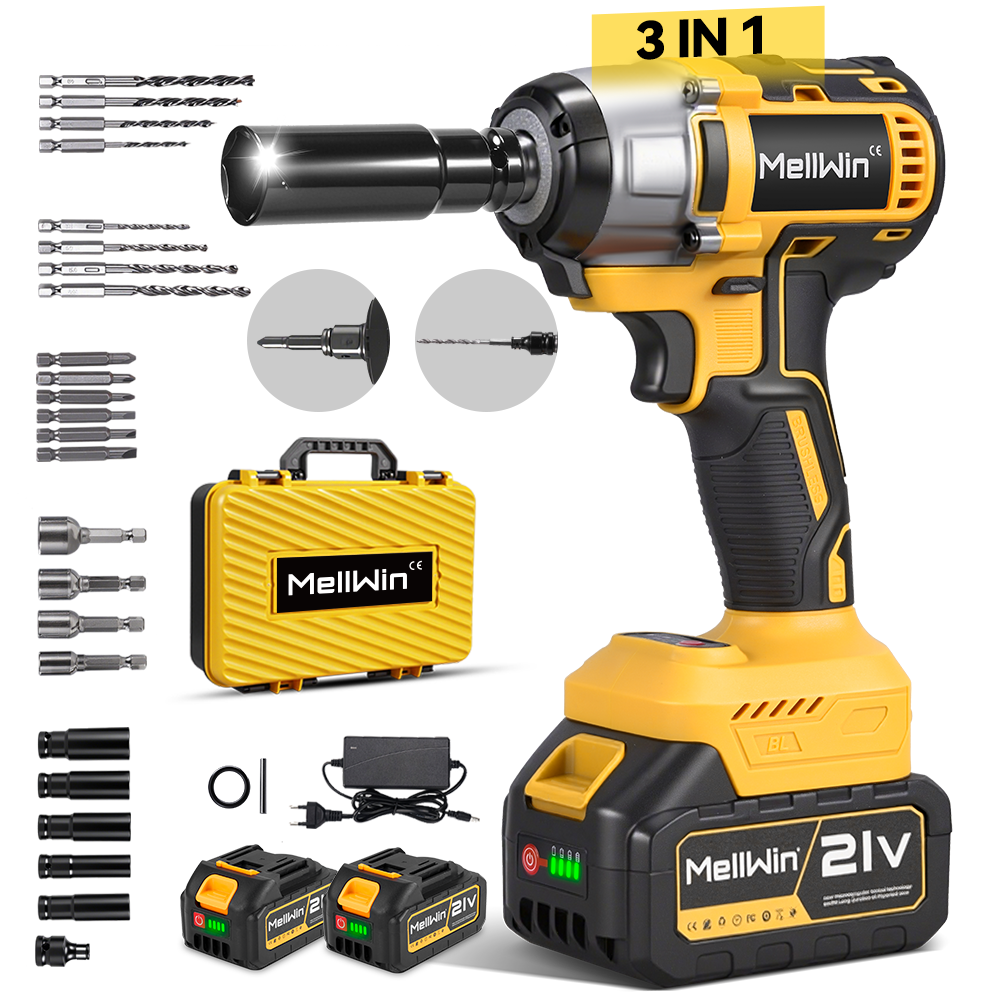
An impact wrench removes and drives bolts far faster than any hand tool. You have three configurations to work with: pneumatic, corded electric, and cordless impact wrench. Each impact wrench is made for a different environment. Before you choose the wrong type of impact wrench, this guide aims to assist you in making an informed decision. You will read impact wrench types, real torque figures, and tips that actually matter on the job.
1. Types of Impact Wrenches
Pneumatic (Air-Powered) Impact Wrenches
A pneumatic wrench uses compressed air from a hose connected to an air compressor. In this tool, a rotary vane motor spins under air pressure, feeding into a hammer-and-anvil mechanism. The hammer generates rotational energy and releases it in rapid bursts against the anvil, facilitating effective torque delivery. It drives the output shaft. That burst sequence is the reason for the torque. There is no steady rotation, but repeated high-force impacts.
Professional garages have incorporated pneumatic tools for many years. Fresh air continuously flows through the motor during operation, so heat does not build up the way it does in an electric motor. You can operate a pneumatic wrench for hours without thermal throttling, making it ideal for demanding environments. Industrial-grade models routinely output torque beyond 3,400 Nm — figures battery-powered tools have not matched.
Advantages
Very high torque output. Lighter body weight than electric tools with similar power. No thermal throttling during extended use. Lower purchase price for the tool itself.
Limitations
Completely dependent on an air compressor and hose. Speed control is basic — many models rely on a forward/reverse collar for rough airflow adjustment instead of true variable-speed electronics. Oil-lubricated pneumatic motors also need air tool oil added to the inlet before each use. Skipping that step can wear the internal vanes quickly.
Corded (Electric) Impact Wrenches
A corded impact wrench takes power directly from a wall outlet, since corded models use a wire, so the voltage stays constant throughout the job. There will be no drop, the way it does when a battery drains under load. Professional-grade corded wrenches reach above 2,200 Nm at the upper end. Furthermore, the electric motor integrates more cleanly with electronic torque controls, making precise adjustment more straightforward than with pneumatic tools.
Advantages
Consistent output from start to finish. No battery replacement cost. Better torque and speed control through electronic settings.
Limitations
The cord limits movement. For example, you are working around a vehicle and dragging the cable behind you. It will create both inconvenience and a trip hazard. Corded tools are also usually heavier than pneumatic models with similar torque output.
Cordless (Battery-Powered) Impact Wrenches
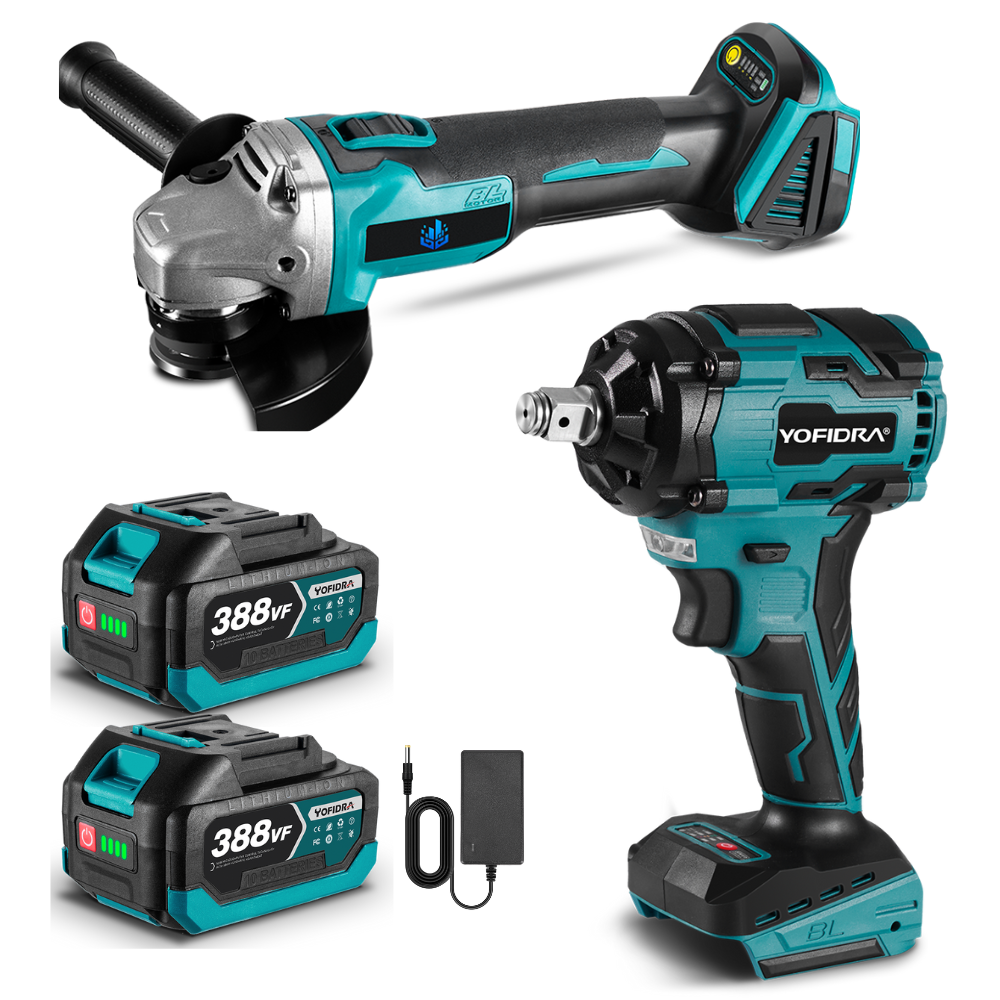
Advancements in battery technology and brushless motor design have significantly improved the efficiency and performance of cordless tools, allowing for longer run times and better torque delivery. First, you need to understand what a brushless motor actually does differently — it uses electronic commutation rather than carbon brushes, so internal friction drops sharply. The motor then runs more efficiently, generates less heat, and lasts far longer than a brushed equivalent.
After that improvement in motor design, manufacturers paired these motors with modern high-capacity lithium-ion packs. Many advanced professional-grade cordless impact wrenches can achieve torque ratings exceeding 1,000 ft-lbs. Imagine these numbers were out of reach for battery tools even five years ago. Some 1-inch cordless models now deliver over 3,000 ft-lbs of nut-busting torque, closing the gap with pneumatic tools in real shop conditions.
Advantages
Full freedom of movement. Fast setup with no hose connections or searching for outlets. Subsequently, it has a compact design that easily fits into engine bays and tight spaces.
Limitations
You can expect 20 to 90 minutes of high-intensity runtime on a single charge. For those who need even more mobile power, the option to add a secondary battery makes it easy to customize the setup to fit your needs.
2. What Is an Impact Wrench Used For
Automotive Repairs
Wheel changes are the most common starting point, but automotive use goes much further than that. Most passenger vehicle lug nuts require between 80 and 120 ft-lbs — a standard ½-inch drive handles this without difficulty. Suspension components are a different matter entirely. Control arm bolts, strut mounts, and subframe hardware frequently require 150 to 300 ft-lbs, and corrosion causes these fasteners to seize well beyond their original torque spec.
The hammer mechanism plays a crucial role in delivering bursts of torque, which are essential for loosening rusted or seized fasteners effectively. Unlike a breaker bar, which applies steady rotational force, an impact wrench delivers repeated high-force pulses, making it more effective for loosening stubborn or rusted fasteners. This is a pulse action that breaks corrosion free without concentrating stress at a single point on the thread. This often just means the difference between a clean removal and a snapped bolt. Brake caliper bolts, axle nuts, and engine bracket hardware all fall into the same category — heavy enough to warrant an impact tool, sensitive enough that torque control matters.
Heavy Equipment Maintenance
Tractors, forklifts, and construction machinery use large-diameter fasteners torqued to 500 ft-lbs and well beyond. Hand tools usually cannot loosen these fasteners. A high-torque pneumatic or cordless wrench with a ¾-inch or 1-inch drive makes teardown and reassembly of this equipment practical within a normal working shift.
Furthermore, agricultural and mining equipment present another problem. Constant ground vibration progressively tightens fasteners beyond their original installation torque. When attempting to remove a bolt that was installed with a torque of 400 ft-lbs, it may now require up to 600 ft-lbs to break free due to corrosion or vibration. It is important to check both the fastening torque and the breakaway torque listed on the tool's specification sheet to ensure proper usage. The breakaway figure, intended for sustained application of up to 30 seconds against a seized fastener, is the number that tells you whether the tool actually does the job.
Industrial and Manufacturing Assembly
Production lines need speed and consistent repeatability across hundreds of identical joints per shift. An impact wrench driven by compressed air or a high-capacity battery maintains consistent output across each fastener without the torque variation that comes with operator fatigue on hand tools. Moreover, steel structure assembly, large equipment mounting, and heavy bolt installation all benefit from the combination of high torque and rapid cycling that impact tooling provides.
Construction and Framing
Steel frame connections, scaffolding bolts, threaded rod anchors in concrete — standard impact wrench territory on any construction site. In terms of timber framing — decking, heavy fencing, structural posts, lag bolts, and structural screws seat sit more completely with the impact mechanism than a standard drill. This is particularly true in dense hardwood, where resistance stays high throughout the full depth of the fastener.
Home Renovation and DIY Projects
You do not need to be a tradesperson to get practical value from one. Deck boards, fence posts, gate hardware, cabinet mounting, and heavy flat-pack furniture assembly all go faster with an impact wrench than a manual ratchet. It's important to utilize the torque settings on modern cordless impact wrench. For lighter jobs, dial back the power to prevent damaging wood or stripping screws on fasteners that do not require full force.
Plumbing and Electrical Work
Conduit fittings, pipe coupling hardware, and panel mounting brackets are not individually complex tasks. After a few hours of doing them by hand across a working day, however, the physical strain builds up, and the job slows down considerably. An impact wrench moves through repetitive fastening quickly and consistently. And because cordless impact wrenches have no hose or cord, you can work through confined utility spaces and overhead runs without the tool's own setup creating additional obstacles.
HVAC Installation and Maintenance
Ductwork panels, vent system hardware, and components of large HVAC units often involve fasteners that are positioned in challenging locations, such as overhead, within mechanical rooms, or behind panels with restricted access. A compact cordless wrench with a short anvil can access tight spaces without the hindrance of hoses or cords. So for HVAC technicians moving between multiple access points within a building, the time saved across a full installation day adds up considerably.
Marine Applications
Moisture and salt are the two big problems for marine fasteners, stainless steel, monel, and titanium. Deck hardware, engine mounts, and through-hull fittings need proper torque for better protection. Removing them for routine maintenance requires a high breakaway force that hand tools cannot reliably produce. A ½-inch or ¾-inch drive impact wrench handles this without damaging the fastener or the surrounding fitting.
Agricultural Equipment
Tillers, harvesters, irrigation equipment, and trailers all work in field conditions where a fixed power supply is rarely available. So a cordless wrench with a spare battery is the practical answer for field repair. Ground vibration during operation causes bolts to tighten beyond their installation spec over time — you will regularly run into fasteners that resist hand tools even when they were originally installed at moderate torque values.
Emergency Roadside Repairs
A flat tire on a highway with nothing nearby is not a situation to manage with a manual lug wrench. A compact cordless impact wrench stored in your vehicle handles the swap in a few minutes — no compressor, no outlet, no setup. Ensure that the battery is fully charged before embarking on a long journey, and regularly check the condition of the tool for optimal safety and performance. That is the only preparation required.
3. Advantages of Cordless Impact Wrenches
Portability and Flexibility
No cords, no hoses, no compressor to move around — the tool goes where the work is. This matters most on multi-story construction sites, remote field settings, roadside situations, and any workspace where running fixed infrastructure creates logistical problems that an air-powered or corded tool simply cannot avoid.
Modern Battery Technology
Advancements in battery technology have significantly improved the performance and convenience of cordless impact wrenches. Today’s lithium-ion batteries offer high energy density, longer runtimes, and faster charging compared to older battery types. A typical cordless impact wrench battery from a major platform usually features at least 4 ampere-hours (Ah) of capacity, providing ample power for demanding tasks such as lug nut removal, lag bolt installation, and structural fastening.
For higher torque applications—tools rated above 1,000 ft-lbs—using an 8 Ah battery pack is recommended. These higher-capacity batteries deliver extended runtime and more consistent power output, enabling users to complete heavy-duty jobs more efficiently without frequent recharging.
Additionally, selecting batteries and chargers within the same platform ensures seamless compatibility and interchangeability across multiple cordless tools, simplifying workflow and reducing the need for multiple charging systems.
Ease of Use and Reduced Setup Time
Connect the battery and the tool is ready. No air line to attach, no pressure to set, no outlet to locate. Then, you simply get to work. For a mechanic running between job sites or a contractor working across multiple building levels, that time saved on setup and teardown adds up meaningfully over a full working week.
4. How to Choose the Right Impact Wrench
Matching Torque to the Job
First, you need to match the drive size and torque rating to what the job actually demands. For standard automotive work — tire changes, brake hardware, suspension bolts — a ½-inch drive with 300 to 500 ft-lbs covers most needs. Larger fasteners and heavy equipment call for a ¾-inch or 1-inch drive with 600 to 1,000 ft-lbs or above. For lighter general work, a ⅜-inch model with up to 200 ft-lbs is sufficient and noticeably lighter to handle all day.
You should generally select a tool rated to at least twice the torque you typically need. That reserve handles seized or corroded fasteners without running the motor at its limit, which also extends motor life.
The NewBeny 1000 N.m Cordless Impact Wrench is a reliable choice for standard automotive and construction tasks. It uses a 1/2-inch drive and provides enough power for most common bolts and fasteners.
Similarly, for heavy industry, the NewBeny 3/4-inch 3300 N.m Brushless Cordless Impact Wrench is designed for high-torque applications. It easily handles large machinery, agricultural equipment, and heavy structural fasteners.
Workspace and Mobility Needs
In terms of workspace, do you have a fixed air supply installed, or are you moving between locations? A fixed workshop with an existing air supply — pneumatic is a strong long-term choice. Moving between locations with no reliable power? Cordless is the correct answer. Stationary work with a consistent wall outlet and no battery budget? Corded removes the charge variable entirely.
Total Cost of Ownership
Pneumatic tools look inexpensive on the shelf. Meanwhile, the compressor, maintenance, lubrication, and air line infrastructure add real ongoing costs that change the picture over time. Cordless tools often have a higher initial price, and their battery packs degrade over time, requiring eventual replacement. Corded tools sit between the two — no battery cost, but limited by cord length. You'll want to factor full lifecycle cost into the decision, not just the shelf price.
Safety and Ergonomics
Impact wrenches generate 90 to 100 dB during operation. Hearing protection for sessions beyond 15 minutes is not optional — noise-induced hearing damage is cumulative and permanent. Safety glasses are standard for all impact wrench work, as the hammer mechanism on corroded fasteners occasionally sends metal fragments in unexpected directions. Furthermore, adjustable torque settings on modern tools reduce the risk of thread damage on sensitive fasteners where over-tightening causes real problems downstream.
5. Tips for Using Cordless Impact Wrenches Effectively
Battery Management
First, charge the battery off regularly rather than running it flat before recharging. Then, rotate between two batteries on heavy days so one is always ready. Just make sure batteries are stored away from direct heat and freezing temperatures — both conditions shorten cell life faster than regular use does.
Socket Selection
You will need impact-rated sockets — not standard chrome-vanadium ones. Standard sockets are not built for repeated shock loads and can fracture during use. Impact sockets have thicker walls and a black oxide finish. They flex under load rather than cracking. Also, confirm the socket seats fully on the fastener before pulling the trigger. A partially seated socket spins off the fastener head and rounds it completely.
Torque and Speed Control
First, you should start at a lower speed setting on unfamiliar fasteners because if you run full torque immediately on smaller bolts, there is a risk of stripping threads. Variable-speed triggers let you run the fastener down slowly first to confirm proper thread engagement. After that, accelerate to full speed to drive it home.
Storage and Upkeep
After each use, wipe the tool down and clear debris near the motor inlet and exhaust areas, as grime accumulation can lead to premature wear. Also, check that body screws remain tight periodically, as vibration works them loose over time. Remove the battery if the tool sits unused for more than a few weeks, and keep a spare battery charged and with the tool so it is ready when you need it.
6. Common Mistakes to Avoid When Using a Impact Wrench
Using the Wrong Drive Size
Using a ½-inch cordless wrench is not appropriate for 1-inch industrial flange bolts, as it cannot provide the necessary torque or force. Running an undersized tool against high-resistance fasteners overloads the motor and consistently fails to reach the required torque. On the other hand, applying a high-torque tool to small fasteners destroys threads immediately. You should generally match drive size and torque rating to the fastener specifications — close enough does not work here.
Skipping Lubrication on Pneumatic Tools
Pneumatic motors need one or two drops of air tool oil at the inlet before each session. This lubricates the internal vanes and prevents premature wear. Regular maintenance checks can help identify any degradation in the tool before it fails mid-job, minimizing downtime and repair costs.
Treating the Impact Wrench as a Torque Wrench
An impact wrench is built for speed and force, not final precision. So for safety-critical applications — lug nuts, brake hardware, suspension joints — you should always finish with a calibrated torque wrench to confirm the final value against the manufacturer's specification. An over-torqued lug nut warps brake rotors and makes future removal very difficult.
Ignoring Basic Safety Precautions
Eye protection is a critical safety requirement and should always be worn during the operation of impact wrenches to prevent injury. Keep hands clear of the rotating socket and anvil during operation. For overhead work or confined spaces with corroded fasteners, add a face shield. High-torque hammer action on seized hardware sends metal fragments in directions you cannot predict.
7. Conclusion
Impact wrenches cut time across nearly every fastening job. Pneumatic tools own the fixed professional shop. Corded models suit stationary workstations. So for most people — and the widest range of tasks — a cordless impact wrench now matches or closely approaches both alternatives in raw performance, while adding the mobility that neither can offer.
8. FAQ
What makes cordless impact wrenches better than corded or pneumatic models?
Mobility is the primary advantage — no airline, no outlet required. Brushless motors and high-capacity lithium-ion batteries have closed the performance gap substantially. Top cordless impact wrenches now exceed 1,000 ft-lbs of fastening torque, which covers the full range of automotive and general construction work.
Can you use a cordless impact wrench for heavy industrial tasks?
Yes, with the right model. Professional-grade cordless wrenches with ¾-inch or 1-inch drives and high-capacity battery packs handle most industrial bolting. For torque requirements above approximately 2,500 Nm, high-capacity pneumatic or hydraulic tools are often more suitable; however, always evaluate the specific task requirements and tool specifications.
How long does a cordless impact wrench battery last?
Between 20 and 90 minutes of active use, depending on battery capacity and torque load. A 5 Ah or larger battery at moderate torque settings gives the longest runtime. A spare battery on hand is the practical answer for heavy work days.
What safety gear is required when using an impact wrench?
Safety glasses and hearing protection at a minimum. For overhead or confined-space work involving corroded fasteners, add a face shield. Heavy-duty work gloves reduce vibration exposure and protect against debris during high-torque applications.
How do you maintain a cordless impact wrench battery?
Avoid full discharge cycles — partial top-offs work well for lithium-ion chemistry. Keep batteries away from direct heat and cold storage. Rotate between packs if you have two. Replace any battery that loses charge noticeably faster than normal under a standard working load.