Using the wrong size can make an impact wrench ineffective on a job. You might buy the most expensive tool on the shelf, but if the drive size does not match your fastener, you end up with stripped bolts, cracked sockets, and a lot of wasted time. Drive size is the first thing to sort out - before brand, before battery voltage, before anything else.
1. Understanding Impact Wrench Sizes
What Does Size Mean in Impact Wrenches?
Drive size is the square-shaped metal post sticking out from the front of the tool - the part that locks into a socket. Measured in inches, that square post is what physically connects your wrench to the fastener.
Five standard sizes are recognized across the industry:
- 1/4" Drive: Smallest tool for light work like electronics or small screws. It has low power (30–80 Nm).
- 3/8" Drive: Stronger but still light. Good for small engines and car brakes (60–250 Nm).
- 1/2" Drive: The most popular size. Best for changing tires, fixing cars, and general building (200–1,200 Nm).
- 3/4" Drive: For heavy jobs like big trucks, cranes, and large machines (700–3,300 Nm).
- 1" Drive: For the biggest industrial jobs like mines. Used for massive bolts with very high power (over 2,000 Nm).
Drive size decides which sockets you can use, so you can’t swap them around freely. A 1/2" wrench needs 1/2" drive impact sockets. While adapters can bridge the gap, they may introduce potential weaknesses in the system if not used correctly. Frequent use leads to power loss and increased tool wear, so always match your socket to your drive size when possible.
Importance of Choosing the Right Size Impact Wrench
Ensures Safety
An underpowered wrench may cause the user to apply excessive force. Ultimately, you may lose control of your hand. Therefore, choosing the right size is important because torque goes to the fastener, not your hand.
Improves Work Efficiency
A properly sized wrench tightens bolts efficiently. For example, it reduces heat, protects threads, and saves time. In a busy workshop or on a site with tight deadlines, that difference is real and measurable.
Extends Equipment Lifespan
Overusing a small wrench on big bolts damages its internal mechanism more quickly than normal wear. Equally, jamming an oversized wrench onto a tiny bolt stresses both the tool and the fastener in ways that shorten the life of each. The right pairing reduces that stress on both the tool and the fastener.
Provides Precise Connections
Engine assembly, aerospace work, and structural steel all have exact torque values that must be reached - not exceeded, not missed. The right size wrench, set to the correct gear and speed, consistently ensures that bolts are tightened to the specified torque. Guesswork should be minimized in those environments, as precision is critical.
Reduces Maintenance Costs
Bearings, anvils, and drive pins wear out faster when a tool is consistently operated outside the torque range for which it was designed. Using the correct size helps maintain internal components within their design limits, which can help reduce repair bills and replacement cycles.
2. What Size Impact Wrench Do I Need?
Automotive Repair and Maintenance
Tasks: Tire changes, lug nut removal, brake caliper replacement, suspension work, oil drain plugs, hub and rotor swaps.
Recommended sizes:
- 1/2" drive - Covers the vast majority of passenger car and light truck work without any issue. Standard lug nuts on most vehicles land between 100-150 Nm. A good 1/2" wrench handles that range easily.
- 3/8" drive - A better fit for brake line fittings, sensor bolts, and anything deep inside a crowded engine bay where the extra bulk of a 1/2" tool becomes a problem.
- 3/4" drive - Lifted trucks, large SUVs, and commercial vehicles with lug nut specs at 200 Nm or above are where this size earns its place.
Tool types: For garage mechanics and mobile repair work, a cordless impact wrench is the obvious choice. Cordless tools allow easy mobility without cords or hoses. High-volume shops often prefer pneumatic tools for their consistent torque over an eight-hour shift. Since they run on shop air, there’s no need to monitor battery levels. While corded electric tools are an option, the cable is usually a major hindrance in a crowded garage.
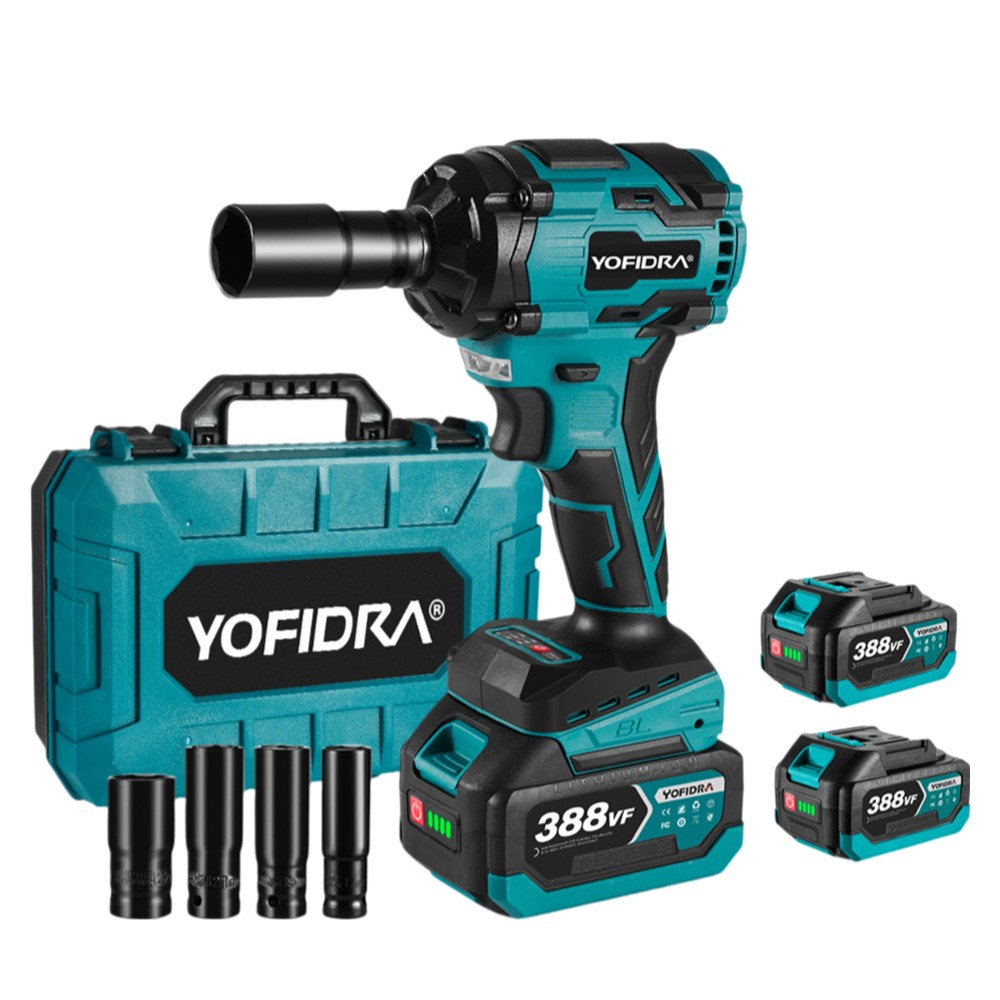
For most automotive repairs, the NewBeny 1/2" 1000 Nm brushless cordless wrench is a reliable choice. It pushes 1,000 Nm through a brushless motor; the whole tool weighs 1.45 kg, it runs spark-free, which matters inside a fuel-adjacent garage, and the LED light on the front actually gets used.
Construction, Heavy Equipment, and Industrial Maintenance
Tasks: Steel frame bolting, anchor bolt installation, scaffolding assembly, heavy machinery servicing, excavator and crane maintenance, and large structural fastener work.
Recommended sizes:
- 1/2" Drive Used for standard bolts (M10–M16). Best for building frames and light construction.
- 3/4" Drive Used for large bolts (M20–M36). Best for bulldozers, cranes, and big machines.
- 1" Drive Used for the biggest bolts (above M36). Best for bridges, trains, and mines.
Tool types: Construction sites use both battery and air tools. Cordless impact wrenches are very common among workers because they are easy to move without heavy hoses and air compressors. However, pneumatic tools may be more suitable for underground work and remote areas where access to power sources is limited.
For structural steel and heavy equipment jobs, the NewBeny 3/4" 3300 Nm Brushless Cordless Impact Wrench is worth looking at seriously. Maximum torque is 3,300 Nm. Standard bolts up to M36 and high-strength bolts up to M27 are within its rated range. It spins at up to 8,000 rpm with 9,000 impacts per minute, and 4-gear forward plus 4-gear reverse control lets you dial in the right output for whatever you are working on.
Manufacturing and Assembly Lines
Tasks: Production line fastening, machinery assembly, conveyor frame bolts, motor bracket mounting, and industrial panel installation.
Recommended sizes:
- 1/4" drive - For small fasteners in the M3-M6 range. Electronics manufacturing, appliance assembly, and any precision work where going even 10 Nm over spec breaks something.
- 3/8" drive - M6 through M12 fasteners in general manufacturing environments and lighter machine assembly.
- 1/2" drive - Heavier assemblies where torque needs to land consistently in the 100-500 Nm band.
Tool types: Cordless, corded, or air?
- Cordless impact wrench: Best for most people. Easy to carry, no hose, very convenient
- Corded impact wrench: Good for steady power, but less flexible because of the cable
- Air: Great for workshops with an air compressor. Strong, reliable, and common in professional garages
If you are buying only one tool for automotive work, a cordless 1/2-inch impact wrench is usually the best option.
Home DIY, Woodworking, and Light Workshop Use
Tasks: Furniture building, deck construction, fence repairs, cabinet installation, machine bolt tightening in the workshop, and general household repairs.
Recommended sizes:
- 1/4" drive - Cabinet hinges, furniture bolts, small hardware. The right size for small fasteners that strip easily if you apply too much torque to them.
- 3/8" drive - Deck screws, fence bolts, most workshop fasteners. More range than the 1/4" without the bulk of a 1/2".
- 1/2" drive - Shed building, lag bolt work, or any vehicle repair done at home. This is the ceiling for most DIY use cases.
Tool types: A battery-powered cordless wrench is the right starting point for home use. No compressor taking up corner space, no cord to run out to the garden. A lightweight 1/2" model with a mid-capacity battery gets through nearly everything a home owner or weekend DIYer will encounter. At least three speed settings are a feature worth paying for - it stops you from blasting a 6 Nm furniture bolt with a tool designed to break loose M18 lug nuts.
Specialized Applications and Tight Spaces
Tasks: Engine bay work, under-dashboard jobs, wall cavity access, pipe flange fitting in confined areas, and electrical panel maintenance.
Recommended sizes:
- 1/4" Drive Smallest size for tight spots. It has less power but fits where others cannot.
- 3/8" Drive Good for engines and dashboards. It is stronger than 1/4" but still fits in small areas.
- Stubby and Right-Angle Short or L-shaped tools in 3/8" or 1/2" sizes. These are best for very narrow spaces.
Tool types: Compact cordless models are the dominant choice in tight spaces. A short body length makes it possible to reach angles that a full-size tool cannot. Right-angle attachments extend this further. Pneumatic tools also fit in tight spots, but the trailing air hose adds bulk and can pull the tool off-center, potentially stripping the fastener. If confined-space jobs are part of your regular work, buy a tool sized and shaped for that purpose - do not shove a full-size wrench into a gap it was never designed to fit.
3. How Do You Choose the Proper Size of an Impact Wrench?
Matching Drive Sizes to Common Fastener Types
Quick reference before you buy:
|
Fastener Size |
Drive Size |
|
M3-M6 (small bolts, screws) |
1/4" |
|
M6-M14 (general automotive, light construction) |
3/8" |
|
M12-M22 (lug nuts, brake bolts, structural) |
1/2" |
|
M20-M36 (heavy equipment, large structural) |
3/4" |
|
M30 and above (industrial, mining) |
1" |
When the fastener size is unclear, pull the service manual or fastener data sheet. Both list torque requirements in Nm or ft · lb. Cross-reference that number against the wrench output range, and the drive size follows logically.
Power Source Comparison: Cordless, Pneumatic, and Corded Impact Wrenches
Cordless (Battery): Lithium-ion technology has come far enough that a good battery impact wrench now matches many pneumatic tools on raw torque output. The freedom to work without a compressor or trailing cord is the real selling point. The trade-off is finite runtime - for long continuous sessions, a spare battery kept on the charger is the practical solution.
Pneumatic (Air-powered): Air tools put out steady torque hour after hour without slowing down. Shops with existing air lines still lean on these for that reason. The motor design is simpler, so the tool body tends to be lighter than an equivalent cordless model. The downside is obvious: you need a compressor, and the hose puts a physical limit on where you can go.
Corded Electric: Corded tools are often most effective in fixed workstations or workshops where a wall outlet is readily available. No battery to manage, no compressor to feed. But take one to a job site or a parking lot, and the cord becomes a problem fast. These corded tools are essentially designed for use as benchtop tools in stable environments.
Lightweight and Ergonomic
Tool weight affects comfort during extended overhead work. Swapping a tire in 45 seconds is different from bolting steel overhead for a full day. For extended or repetitive overhead work, staying under 2 kg on a 1/2" tool makes a real difference by the end of the day. Rubber grips and a balanced design reduce hand fatigue. If your work is mostly vertical - scaffolding, ceilings, roof framing - weight should probably rank above torque output when comparing two otherwise similar tools.
Torque Range and Variable Speed Settings
Check not just the maximum torque, but also the minimum torque and speed settings. A single-speed 1,000 Nm wrench is not a tool you want near a plastic trim bolt or an M6 sensor fitting. Variable speed triggers and selectable gear modes let you ramp up gradually, which is how you avoid turning a straightforward repair into a parts-ordering situation. Automotive work benefits from at least three speed steps. Industrial use calls for four-gear models with independent forward and reverse speed control.
Budget Considerations and Finding Widely Compatible
Under $80 gets you an entry-level cordless wrench that is fine for home use - expect 150-300 Nm on a 12V or 18V battery. The $80-$180 range covers most automotive and construction needs, with torque output in the 400-1,000 Nm band. Above $180, you are buying brushless motors, better build quality, longer warranties, and torque above 1,000 Nm.
Battery platform compatibility is worth thinking through carefully. If your workshop already runs on 18V tools, adding an impact wrench on the same battery family means one charger, one set of spare batteries, and less clutter. NewBeny's cordless impact wrench range is compatible with Makita 18V B-series lithium batteries - useful for anyone already invested in that ecosystem.
4. Common Mistakes to Avoid When Using an Impact Wrench
Using the Wrong Size or Incorrect Sockets
One common mistake is using the wrong size impact wrench or the wrong socket. A tool that is too small may not have enough power, while a tool that is too large can damage bolts and nuts. Another mistake is using regular chrome sockets instead of impact sockets. Regular sockets are not made for the strong force of an impact wrench and can crack. Impact sockets are made for this kind of pressure and are much safer to use. It is also best to use the correct drive size instead of relying too much on adapters.
Over-Tightening or Under-Tightening Fasteners
Over-torquing stretches bolts past their elastic limit, strips threads, and in worst cases snaps the fastener entirely. Under-torquing is its own problem - bolts that are not properly seated work loose under vibration, which is a safety issue on vehicle wheels and structural joints. A torque stick or adjustable torque setting provides a more accurate torque application. For any tasks with a specified torque value—such as lug nuts, head bolts, and suspension fasteners—using a calibrated torque wrench is highly recommended to ensure accuracy.
Ignoring Battery Charge Levels or Compressed Air Quality
A low battery can make a power tool weaker without a clear warning. This means the tool might stop before a bolt is tight enough, which can be dangerous for important jobs. You should always check the battery charge before you start. For air-powered tools, water and dirt in the air supply can cause the inside of the tool to rust or lose power. To keep your tools working perfectly and lasting a long time, you must use air filters and drain the water from your air compressor tank regularly.
Neglecting Safety Gear and Operational Safety Procedures
These tools generate high rotational force in a fraction of a second. Eye protection stops metal fragments from reaching your face. Close-fitting gloves protect your hands without creating a new hazard - loose gloves catch on rotating parts. Keep the hand that is not holding the wrench well away from the drive end. In tight spaces on construction sites, an accidentally triggered tool can injure both the operator and anyone working nearby.
Applying Excessive Pressure or Incorrect Handling Techniques
Applying unnecessary pressure on the tool does not enhance performance; the internal hammer mechanism is responsible for delivering the torque. What extra pressure actually does is reduce control, tire your arm, and push the socket off-axis. Keep the wrench straight against the fastener. Any angle between the drive and the socket increases wear on both parts and raises the chance of the socket coming loose mid-operation.
5. How to Maintain Your Impact Wrench
Regular Cleaning and Lubrication
After a day of use, wipe the exterior down with a dry cloth and clear any metal filings from around the drive area. Pneumatic tools need a few drops of air tool oil at the inlet before and after use - this keeps the internal vanes lubricated and slows rust buildup inside the housing. For cordless tools, the battery contacts benefit from a monthly clean with a dry brush; oxidised contacts rob performance more than most people notice until it is already a problem.
Checking and Replacing Wear Parts (e.g., Brushes, O-rings)
Brushed motor tools have carbon brushes that wear down gradually. Reduced power output and increased sparking during use are the signs they need replacing - not a difficult fix, but one that gets ignored until the tool stops working mid-job. In pneumatic tools, the O-rings that seal air passages harden and crack over time. Visible air leaks from the housing point to these seals. Brushless cordless tools - like those in the NewBeny range - skip the brush replacement issue altogether, but the anvil and drive pin still need a visual check every few months under daily use.
Proper Storage Practices to Avoid Rust and Damage
Keep your tools dry in a case or bag. The purpose is to protect the internal parts from rust. Store the wrench so nothing heavy leans against the drive tip, or it may bend. Subsequently, remove the battery if the tool is not in use for a few weeks to prevent it from dying permanently.
Battery Care Tips for Cordless Impact Wrenches
The ideal storage charge for lithium-ion batteries is somewhere between 20% and 80%. Storing at full charge or running completely flat both push degradation faster over time. Heat is the other major issue - a battery left in a car on a hot day takes a permanent knock to long-term capacity. For optimal storage, charge unused batteries to around 50%. Always use the original charger or one confirmed compatible by the manufacturer - mismatched chargers shorten cell life noticeably.
6. Conclusion
Match impact wrench size with the specific job for optimum performance and safety. A 1/2" cordless impact wrench covers the majority of automotive and mid-level construction work. Step up to 3/4" cordless impact wrench when bolts get large, and torque specs climb past what a 1/2" cordless impact wrench can safely put out. For precision work in tight access points, a 3/8" cordless wrench or 1/4" cordless impact wrench gives you the control the job needs without the risk of over-torquing. That pairing - drive size to fastener type - shapes how safe the work is, how long the tool lasts, and whether the connections you make actually hold.
7. FAQs
Can I Use a Cordless Impact Wrench for Heavy-Duty Jobs?
Yes, and modern brushless impact wrench handle it well. A quality cordless wrench now puts out torque that competes with many pneumatic tools. The NewBeny 3/4" 3300 Nm cordless impact wrench is one example: 3,300 Nm through a brushless motor with 4-gear control, no air line needed. The main variable is the battery charge going into the job. Start with a full battery and keep a spare ready for extended sessions.
Is a Larger Impact Wrench Always Better?
No, and this is a mistake that comes up often. A large-drive wrench on a small fastener over-torques and strips the bolt before you even notice the problem. Drive size needs to match the fastener range and the torque spec for that fastener. A 1" drive on an M12 bolt is inappropriate, regardless of its power.
How Do I Determine the Required Drive Size for My Vehicle's Lug Nuts?
Your vehicle owner's manual lists the lug nut torque specification. Most standard passenger cars fall between 100-130 Nm, which a 1/2" wrench handles without difficulty. Larger pickup trucks and commercial vehicles often specify torque above 200 Nm, making a 3/4" drive a suitable choice for safe removal and installation, alongside other options.
Are Cordless Impact Wrenches Suitable for Professional Use?
Most professional mechanics now use battery tools instead of air tools. New motor technology makes battery tools just as strong as air tools. They are much easier to use because you do not need a heavy air compressor or a power outlet. Air tools are still good for shops with built-in air lines, but battery tools are now the top choice for mobile and site work.
What Drive Sizes Are Most Common Among Professionals?
The 1/2" drive leads across automotive, construction, and general trade work - it handles the widest range of jobs and is the most versatile size to own. The 3/8" sits second, used heavily by mechanics on detailed engine work and brake systems. The 3/4" is standard in heavy equipment maintenance and structural steel. Most experienced tradespeople carry at least two sizes - a 1/2" for everyday use and either a 3/8" or a 3/4", depending on the work they specialise in.