An impact wrench fastens and removes bolts by using rapid rotational impacts. It does not rely on continuous torque like a regular drill. It works faster than a drill and can remove stuck bolts that you cannot remove with hand tools. Pneumatic, corded, and cordless impact wrenches each have unique advantages and disadvantages that cater to different applications.
This guide shares how they work, how they compare to similar tools, and what to know before you buy or use one.
1. What Is an Impact Wrench
What Exactly Defines an Impact Wrench?
Inside the tool, a rotating hammer hits an anvil in short, rapid bursts. It generally hits 1,500 to 3,200 times per minute. This repetitive impact force drives the fasteners into place. Instead, it works in short bursts rather than spinning continuously. It's the reason an impact wrench can break loose a seized bolt that would stall a regular drill.
One detail that many instructional guides overlook is that the anvil operates under dynamic shock load, which is why you must use impact-rated sockets. These are made from chrome-molybdenum steel, so they can handle repeated shocks without breaking. Standard chrome-vanadium sockets, the type found in most basic socket sets, can fracture under impact load. A broken socket fragment is a real safety hazard, not just a tool issue.
The History and Evolution of Impact Wrenches
Chicago Pneumatic built the first commercial pneumatic impact wrench in 1935. The problem was its heavy weight and need for a big compressor, so it was mostly used in industries. Later, auto shops adopted air-powered models through the 1950s and 60s, and pneumatic tools dominated for decades due to the limitations in the power of battery technology at that time.
The improvement started when brushless motors became available around 2012–2015. When paired with advanced lithium-ion batteries, performance improved significantly. Modern brushless cordless models with high-output 18V batteries now deliver torque comparable to mid-range pneumatic tools. This was not possible ten years ago.
2. Types of Impact Wrenches
Pneumatic (Air-Powered) Impact Wrenches
Working Principle
Compressed air spins a rotor connected to the hammer mechanism. Then, the hammer hits the anvil repeatedly, which turns the output shaft. It is important to note that CFM (Cubic Feet per Minute) is a key limiting factor in the performance of pneumatic impact wrenches. A tool rated for 5 CFM at 90 PSI will underperform on a compressor that only delivers 3 CFM, even if the pressure gauge reads correctly.
Advantages
Light for the torque they produce. No battery to manage. Output stays consistent as long as the air supply holds.
Applications
Tire shops, assembly lines, fleet maintenance. It is used in places where there is a properly sized fixed compressor. Still, the preferred choice in shops where tools run for hours daily.
Corded Electric Impact Wrenches
Working Principle
An electric motor runs the corded impact wrench to spin the hammer and hit the anvil. Because it plugs into a wall outlet, it provides consistent power without draining like a battery.
Advantages
No batteries, no compressor, unlimited runtime. Generally, it is less expensive than a comparable cordless kit when you factor in battery pack costs.
Applications
Fixed workshop use. Useful for HVAC and electrical work near a power source. Although it is less common now due to advancements in cordless models, corded impact wrenches remain useful for fixed work areas.
Cordless (Battery-Powered) Impact Wrenches
Working Principle
In a cordless impact wrench, a rechargeable battery powers a brushless motor. It drives the hammer mechanism. Brushless motors use electronic control instead of carbon brushes, so they produce less heat, less wear, and use battery power more efficiently. That efficiency is why modern cordless impact wrenches have overcome pneumatic tools in practical torque output.
Advantages
Full mobility — no hose, no cord. Battery platforms let you share packs with drills, saws, and other tools. Variable torque settings let you dial back for smaller fasteners.
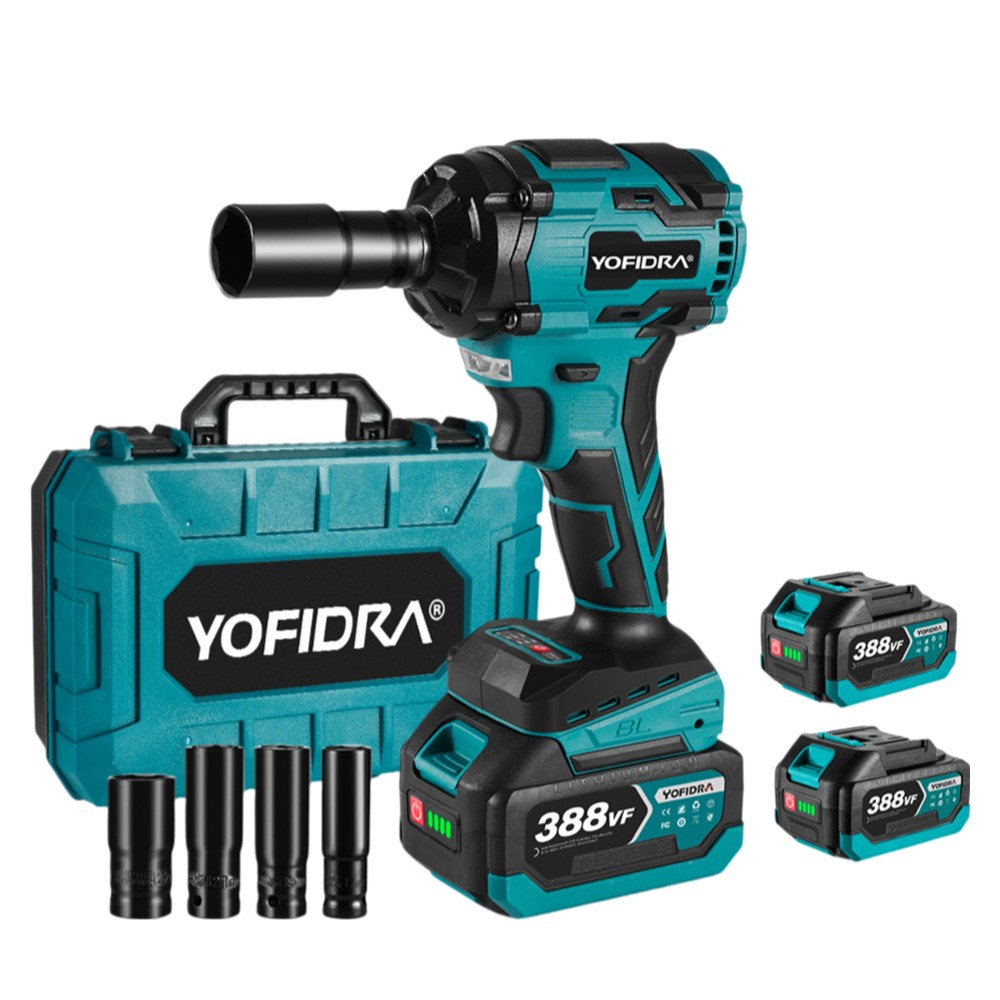
If you are looking for a reliable cordless option, NewBeny 1/2" 1000N.m impact wrench is a good choice for your home and garage. For heavier work, a 1000N · m model gives much power.
Applications
Construction sites, roadside tire changes, home garages, and field service work. Now, Cordless impact wrenches can perform many tasks that previously required a compressor, such as automotive repairs and construction.
Hydraulic and Other Specialized Impact Wrenches
Working Principle
Hydraulic fluid under pressure drives the rotation. These tools are sealed and spark-free, which makes them safe in environments where electricity or compressed air would be a hazard.
Advantages
Works underwater and in explosive atmospheres. Torque output can reach 10,000+ ft-lbs for large industrial bolting.
Applications
Subsea equipment, oil refineries, bridge construction, and mining. It is not used in general work, but it is good to know about this type.
3. How Impact Wrenches Differ from Other Fastening Tools
Impact Wrench vs. Impact Driver
Impact Wrench
- Drive Type: Uses a square drive tip ( 1/2-inch, 3/8-inch, or 3/4-inch) to attach heavy-duty sockets.
- Power: Extremely high torque, often reaching over 1,500 ft-lbs.
- Best Use: Heavy-duty automotive and construction tasks, such as removing lug nuts from car wheels or securing large structural bolts.
Impact Driver
- Drive Type: Uses a 1/4-inch hex chuck (six-sided fitting) for quick-change bits.
- Power: Generally lower power, usually capping out around 200 ft-lbs.
- Best Use: Driving long screws into wood or tightening small bolts where a drill might stall.
Impact Wrench vs. Ratchet Wrench (Hand Ratchet)
Impact Wrench
- Function: Trades manual sensitivity for raw speed and high torque.
- Performance: Capable of breaking loose rusted or seized bolts that a human arm cannot move.
- Best Use: Rapid removal and initial tightening of fasteners in open spaces.
Ratchet Wrench (Hand Ratchet)
- Function: Provides maximum control and sensitivity, allowing the user to feel the resistance of the bolt.
- Performance: Its slim profile makes it superior for working in tight, cramped engine bays where large power tools won't fit.
- Best Use: Precise hand-tightening or working in restricted areas.
Impact Wrench vs. Torque Wrench
Impact Wrench
- Function: A rough-in tool designed for speed.
- Measurement: It does not provide a torque measurement; it delivers power based on the internal hammering mechanism.
- Best Use: Quickly driving a fastener into place before the final tightening.
Torque Wrench
- Function: A precision instrument designed to tighten a fastener to a specific numerical value.
- Measurement: Allows the user to meet exact manufacturer specifications to ensure safety.
- Best Use: Critical components like cylinder heads, wheel hubs, or suspension parts where over-tightening could cause part failure.
4. Impact Wrench vs. Cordless Drill (Electric Drill)
Impact Wrench
- Mechanism: Uses repeated internal impacts to create rotational force.
- Performance: Designed to handle high-resistance tasks without burning out the motor.
- Best Use: Loosening stuck lug nuts or heavy machinery fasteners.
Cordless Drill
- Mechanism: Applies smooth, continuous rotation without hammering.
- Performance: Offers far better control for delicate work where stripping threads is a risk.
- Best Use: Creating holes with drill bits and driving smaller fasteners into soft materials.
Impact Wrench vs. Air Ratchet (Pneumatic Ratchet)
Impact Wrench
- Power: Pick up where air ratchets stop, offering significantly higher torque for stubborn fasteners.
- Performance: The go-to tool for rusted or seized bolts.
- Best Use: Ideal for removing or tightening heavily rusted, seized, or large bolts and nuts that require high torque. Perfect for initial loosening or final tightening where maximum force is needed.
Air Ratchet
- Power: It gives moderate torque, ranging between 60 and 100 ft-lbs.
- Function: Acts as a motorized version of a hand ratchet, spinning fasteners in or out quickly.
- Best Use: It is used on the final stage, like threading a nut on before applying final torque, or removing a bolt that is already loose but has long threads.
5. Why More People Are Choosing Cordless Impact Wrenches
Enhanced Portability and Convenience
No compressor to set up. No cord to manage. You pick up the cordless impact wrench, check the battery, and start working. That's a real advantage when you're moving between vehicles, working on scaffolding, or handling a flat tire away from a shop. Portability is very important, and many people choose cordless tools because of it.
Advances in Battery Technology
High-output lithium-ion packs today sustain high current draw without the voltage drop that early cordless tools suffered from. Modern 5.0Ah and 6.0Ah packs on major platforms hold their output through extended sessions. Charge times have also improved — 30 to 60 minutes for a full charge is standard now, which means a spare battery is rarely a problem on a job site.
Increasing Power and Performance
Top-tier brushless cordless impact wrenches now publish 700–1,500 ft-lbs of breakaway torque depending on drive size and platform. A standard shop pneumatic wrench at 90 PSI delivers around 800–1,000 ft-lbs. The overlap in performance specifications between pneumatic and cordless models is significant. For most automotive and construction fastening, the performance ceiling on a quality cordless model is no longer a limiting factor.
For example, NewBeny 1/2" 1000N Cordless Impact Wrench.The Brushless Cordless Impact Wrench can easily handle tough bolts on cars and construction work. It is a good option if you need high power without using air tools.
Versatility Across Different Applications
If you already have some tools on one of these battery systems, then adding a cordless impact wrench is just one more tool that will share the same batteries. Having 3/8", 1/2", and 3/4" drive sizes will allow this platform to handle everything from light work up to heavy equipment. This compatibility is advantageous for those looking to build a cohesive tool set with a single battery system.
Reduced Setup Time and Maintenance
A pneumatic setup involves:
- The compressor
- Moisture trap
- Regulator
- Air line
- Inline oiler
- Hose management before you even start working.
With a cordless tool, you just charge the battery. Cordless: charge the battery. Brushless cordless impact wrenches also require very little ongoing maintenance compared to pneumatic tools, which need daily lubrication and regular air system checks. For occasional users, this simplicity outweighs the need for regular maintenance associated with pneumatic tools.
6. Safety Guidelines for Using Impact Wrenches
Protective Equipment Recommendations
- Wear safety glasses before you use these tools. Glasses will block flying debris. Impact wrenches generally cause fragments, rust, and thread debris to be expelled at speed.
- Similarly, earplugs and face coverings will give you long-term protection against damage and injuries. If you plan for more pneumatic use, add hearing protection—sustained noise above 90 dB causes damage over time. When working overhead or under a vehicle, use a face shield.
- Pick gloves that fit tightly so they do not get pulled into the machine. Gloves help with grip, but avoid loose-fitting ones that could catch on a rotating socket.
Proper Handling Techniques to Avoid Injuries
- Keep both hands on the wrench to stay in control during heavy work. You should maintain both hands on the equipment during work that requires high torque. When a socket becomes stuck on a stripped fastener, the tool will begin to rotate, creating unexpected force on your wrist.
- Double-check your settings before you pull the trigger to save the threads. Always check the direction switch before pulling the trigger, as using reverse while tightening can damage the threads instantly.
- Stay clear of the bolt's path to avoid getting hit by flying parts. The bolt path requires you to keep your distance, as a nut that spins off at high speed can cause a powerful impact.
Maintenance Tips to Keep Equipment Safe and Functional
- Look over your sockets before every job to find any cracks. Check impact sockets before every session. Look for cracks, rounded corners, or any visible distortion at the drive hole. A damaged socket under load can fail without warning.
- Watch for loose parts on the tool's tip where the socket attaches. Check the drive pin and retaining ring on the anvil—lateral play in a mounted socket needs attention before use.
- Put oil in the air intake daily to keep the motor running smoothly. For pneumatic tools, 3 to 5 drops of pneumatic tool oil in the air inlet before each use keeps the internal mechanism in good condition.
7. Troubleshooting Common Problems of Impact Wrenches
Impact Wrench Not Delivering Expected Torque
For pneumatic tools, check CFM before assuming low pressure is the issue. An undersized compressor or restricted hose reduces airflow well below what the tool needs, even when the tank pressure looks fine. For cordless, swap the battery before diagnosing the tool. A battery pack that indicates a full charge but fails to deliver power under load is a common issue with older battery cells— test it in another tool first.
Unusual Noises or Vibrations During Operation
A new grinding or rattling sound indicates that you should stop the tool immediately. In pneumatic tools, this usually traces back to a dry hammer mechanism from missed lubrication. In cordless models, a failing bearing or damaged hammer produces a similar sound. Running the tool with either problem causes further internal damage. Vibration that feels different from normal — heavier or uneven — typically signals a loose internal component.
Battery Issues or Power Loss in Cordless Models
If your battery-powered impact wrench stops functioning during use, first check for common issues such as a depleted battery or a loose connection before checking the temperature. Thermal protection circuits reduce output or shut the tool off when the battery or motor overheats. Let both cool for 15–20 minutes and retry. If the problem continues, test the battery in a different tool. A pack that underperforms specifically with the impact wrench but works fine in a drill likely can't sustain the high current draw that impact wrenches require. That points to a battery replacement.
Air Leakage or Pressure Drops in Pneumatic Wrenches
Leakage at the tool inlet is usually a worn inlet valve seal or O-ring — inexpensive to replace. Pressure drops during use point to a supply problem: a small tank, an undersized hose, or a compressor that can't keep up. Use a 3/8-inch inner diameter (ID) hose as the minimum for impact wrenches. A 1/4" hose creates enough flow restriction to drop usable pressure even when the tank reads correctly — and the effect gets worse with longer hose runs.
8. Maintaining and Caring for Your Impact Wrench
Cleaning Procedures After Use
Wipe down the housing and clear debris from the socket anvil area after each session. For pneumatic tools, run a short burst of clean air through the inlet to remove moisture and small particles. Do not spray solvent into the tool body, as it can damage internal seals and pose electrical hazards in cordless tools.
Regular Lubrication and Part Replacements
Pneumatic impact wrenches need oil every day of use — 3 to 5 drops in the air inlet. This is not optional; the hammer mechanism wears rapidly without it. Cordless tools use sealed, factory-greased hammer assemblies, but a full disassembly and regrease every 200–300 operating hours extends their service life noticeably. The anvil and hammer set are wear parts — replace them when torque output drops and other causes have been ruled out.
Battery Charging and Storage for Cordless Tools
It is important not to keep lithium-ion batteries fully discharged, as this can damage the cells. According to experts, if the battery stays below a certain voltage level for too long, the cells can be permanently damaged, and the charger may not recover them. Therefore, if you are not using your cordless impact wrench, try to maintain a charge level of 40–60%. Subsequently, store battery-operated impact wrench in a cool, dry place.
When to Repair or Replace Parts
Replace impact sockets that exhibit cracks or visibly rounded corners; attempting to use a damaged socket is inadvisable. Check the anvil square for any play with a socket mounted; movement there needs attention before the next session. On brushed cordless motors, brushes wear and typically need replacement after around 50–100 hours of heavy use. Brushless motors last much longer but eventually need bearing service — you'll usually hear the change in sound before it becomes a critical failure.
9. Impact Wrench Accessories and Attachments
Common Sockets and Adapters
You need to use impact-rated sockets such as chrome-molybdenum steel. These sockets have a black finish. The reason is to distinguish them from standard chrome sockets. Deep sockets can easily access recessed fasteners; shallow ones work for exposed lug nuts and bolts. Here is an important point: thin-wall impact sockets are suitable for alloy wheels, whereas a standard socket can contact the wheel face and cause damage. If you regularly work on alloy wheels, thin-wall versions are worth having.
Extension Bars and Universal Joints
Impact-rated extension bars give you extra reach and help you work in tight spaces more comfortably. The shortest bar that accomplishes your task should be used, as longer extensions will bend under heavy torque, increasing the risk of socket slippage. Universal joints let you work at an angle when the fastener is not in a straight line with the wrench. They slightly reduce torque and create more vibration, so use them only when needed.
Protective Covers and Cases for Storage
Boot covers protect the tool housing from drops and chemical exposure on active job sites. Hard cases keep the tool, batteries, sockets, and extensions organized and protected during transport. A dropped cordless impact wrench onto concrete from waist height can crack the housing or damage the motor mount — a decent case prevents that kind of repair cost.
10. Conclusion
An impact wrench is built for one job — applying and removing fasteners with more torque than hand tools can produce, faster than a drill can manage. Use impact-rated sockets, finish spec-critical fasteners with a torque wrench, and maintain the tool properly. Whether you choose pneumatic, corded, or a cordless impact wrench depends on where and how often you work — not on which type sounds most impressive.
11. FAQs
Can I use an impact wrench with any socket?
No. Only impact-rated sockets — made from chrome-molybdenum steel, usually black in color. Standard chrome-vanadium sockets are not designed for shock loads and can crack under repeated impact. A broken socket fragment under torque is a safety risk, not just a tool problem.
How much torque do I need for automotive lug nuts?
Most passenger car lug nuts spec 80–120 ft-lbs. To break loose a rusted or over-tightened lug nut, you want at least 300 ft-lbs of breakaway torque from the tool. Trucks and full-size SUVs often call for 140–165 ft-lbs at final torque, so a 1/2" drive model rated 450+ ft-lbs handles those without working at the edge of its range.
Are cordless impact wrenches powerful enough for heavy-duty work?
For most automotive and construction work, yes. Current brushless cordless models on 18V–20V and 60V platforms regularly produce 700–1,500 ft-lbs of breakaway torque. For high-volume industrial bolting on heavy equipment, where repeated use at high torque specifications occurs throughout the day, pneumatic or hydraulic tools remain the professional standard.
How do impact wrenches differ from standard wrenches?
Standard wrenches and ratchets rely on manual force applied through leverage. An impact wrench generates torque mechanically through repeated impacts — hundreds to thousands per minute — producing far more force than any hand tool can. It also absorbs the shock load internally, so you don't feel it in your wrist the way you would with a breaker bar under load.
What factors should I consider when buying an impact wrench?
Drive size first: 3/8" for lighter work, 1/2" for automotive and general construction, 3/4" for heavy equipment. Then, torque — look at breakaway torque specifically, not just max torque; they're different figures and breakaway is more useful in practice. For cordless, check battery platform compatibility with your existing tools. Weight matters more than it seems for overhead or extended use. Check warranty coverage and local service availability before you buy.
Is it safe to use an impact wrench for delicate applications?
Not for final torque. You can use an impact wrench to run fasteners down quickly, but anything with a torque specification — cylinder heads, suspension components, aluminum threads — needs a calibrated torque wrench for the final step. Impact wrenches don't measure output. Over-torquing fine-pitch or aluminum threads causes stripped fasteners that are time-consuming and expensive to fix.
How often should I lubricate and maintain my impact wrench?
Pneumatic tools: oil before every use; 3 to 5 drops into the air inlet. Skip this consistently, and the hammer mechanism wears out fast. Cordless tools require much less attention day to day — wipe them down after use, keep the battery contacts dry, and plan a full internal service every 200–300 operating hours. On brushed cordless motors, inspect the brushes around the 50-hour mark under heavy use.
What are the best charging practices for cordless impact wrenches?
Charge at room temperature — cold batteries charge slowly; hot batteries are a safety concern. Remove packs from the charger after they're full if your charger doesn't have a maintenance mode. For storage longer than a few weeks, keep batteries at 40–60% charge. A battery stored fully discharged for months can drop below the recovery threshold and become permanently unusable — the charger won't recognize it.
Are pneumatic impact wrenches still relevant with the latest electric models?
Yes, especially in high-volume environments. A tire shop processing 50+ vehicles a day runs pneumatic tools because the air supply never runs out, the tools are lighter than cordless equivalents at similar torque, and there's no battery rotation to manage. The cordless impact wrench has closed the performance gap significantly, but the weight advantage and consistent output of pneumatic tools keep them the standard in shops that run tools all day. Browse the full range of cordless impact wrenches at Newbeny Tool — compact 3/8" wrenches to heavy-duty 1/2" drive kits.