There's a moment every driver dreads — a flat tire on a wet roadside, a lug nut that hasn't moved since the factory torqued it down five years ago, and a flimsy lug wrench that's more wishful thinking than tool. The right impact wrench can save time and help you avoid difficult situations. However, the correct size isn't a straightforward answer; it varies based on several factors. The correct choice depends on three factors:
- The socket size that fits the lug nut hex
- The drive size that determines torque capacity
- And the torque output required for your vehicle.
If any of these are incorrect, the chances are you will damage the lug nut or even break the wheel stud.
1. Understanding Lug Nut Sizes and Torque Requirements for Cars
Before you pick up a wrench, you need to know what you're turning. Lug nuts aren't universal. For example, a Honda Civic and a Ford F-250 have very different wheel and lug nut specifications.
Common Lug Nut Sizes in North America and Europe
The two measurements that matter are the hex size (what socket you need) and the thread size (how the nut screws onto the stud). Most people only know one of these. You need both.
Typical Lug Nut Hex Sizes
|
Hex Size (Metric) |
Inch Equivalent |
Typical Use |
|
17 mm |
~21/32" |
Compact cars, economy sedans |
|
19 mm |
3/4" |
Mid-size cars, crossovers |
|
21 mm |
13/16" |
Full-size trucks, SUVs |
|
22 mm |
7/8" |
Heavy-duty trucks, some commercial vehicles |
The 19mm is probably the most common hex size you'll encounter across a mixed garage — it fits a huge swath of Honda, Toyota, Ford, and GM products. But don't assume. Check your vehicle's manual or look at the existing socket in your spare tire kit.
Typical Thread Size & Pitch
|
Thread Size |
Pitch |
Common Vehicles |
|
M12 x 1.25 mm |
Fine |
Honda Civic, Toyota Corolla, Mazda3 |
|
M12 x 1.5 mm |
Standard |
Subaru Outback, Mitsubishi, and older Fords |
|
M14 x 1.5 mm |
Standard |
F-150 (2015+), Chevy Silverado, RAM 1500 |
|
1/2"-20 UNF |
Imperial fine |
Older American muscle, classic cars |
|
7/16"-20 UNF |
Imperial fine |
Older compact American cars, vintage trucks |
While thread size is more critical when purchasing replacement lug nuts than when selecting a wrench, understanding it helps prevent the selection of incompatible parts. Cross-threading an M12 nut onto an M14 stud can cause serious damage.
Torque Specifications: Why They Matter
What is Torque?
Torque is the rotational force that clamps a lug nut tight against your wheel. Most shops measure this in foot-pounds or Newton-meters. So, what happens if a manual says you need 100 ft-lbs? This means you must tighten that nut until the effort required to turn it reaches that specific mark.
If you under-tighten, the wheel may become loose over time. Driving creates a cycle of heating and cooling that can nudge a loose nut right off the stud. But do not just crank it as hard as possible! Over-torquing stretches the metal. Those studs do not usually snap the second you finish; they fail later, maybe while you are on the highway, because the damage is already done.
Most guides actually miss a massive detail. While an impact wrench is effective for loosening lug nuts or starting the removal process, it should not be the final tool used for perfect torque specifications. You absolutely must finish with a calibrated torque wrench. Is that being too careful? Not really. That is exactly how professional tire shops cover their backs and keep you safe.
Recommended Torque Settings by Vehicle Type
|
Vehicle Type |
Torque Range (ft-lbs) |
Torque Range (Nm) |
|
Compact / Economy Cars |
80 – 100 ft-lbs |
108 – 135 Nm |
|
Mid-size Sedans / Wagons |
85 – 110 ft-lbs |
115 – 149 Nm |
|
SUVs / Crossovers |
95 – 130 ft-lbs |
129 – 176 Nm |
|
Light Trucks (1/2-ton) |
100 – 150 ft-lbs |
135 – 203 Nm |
|
Heavy-Duty Trucks (3/4-ton+) |
150 – 200 ft-lbs |
203 – 271 Nm |
|
Commercial / Fleet Vehicles |
200 – 450 ft-lbs |
271 – 610 Nm |
|
Performance / Track Cars |
Check OEM spec exactly |
Varies widely |
For example, a standard Honda Accord typically requires about 80 ft-lbs of lug nut torque. A Ram 2500 Cummins diesel generally requires around 135 ft-lbs. A semi-truck trailer lug nut typically requires 450–500 ft-lbs of torque.
2. What Size Impact Wrench for Lug Nuts
Now we get into the actual tool selection. There are three dimensions to this: socket size, drive size, and torque output.
Common Impact Wrench Socket Sizes for Lug Nuts
Your socket size has to match your lug nut hex. For Simple.
- 17 mm
- 19 mm
- 21 mm
- 22 mm
17 mm fits compact and subcompact vehicles. Less common on newer platforms. If you're working on a Honda Fit or older Corolla, this is likely yours.
19 mm fits the majority of passenger vehicles on North American roads today. If you only stock one socket, make it a 19mm impact socket.
21 mm is the standard for full-size pickups and larger SUVs. Most people driving a half-ton truck will live here.
22 mm is typically used for heavy-duty trucks and some commercial vehicles. Less common in a home garage, essential in a fleet shop.
It is important to use impact-rated sockets rather than chrome hand-tool sockets for safety and performance. Standard chrome sockets can shatter under the percussive force of an impact wrench. Impact sockets are made from chrome-molybdenum steel, finished in black oxide, and are built to absorb that hammering without cracking.
Common Impact Wrench Drive Sizes for Lug Nuts
Drive size refers to the square connector on the wrench that attaches to the socket. It directly determines how much torque the tool can physically transmit.
- 1/2-inch Drive
- 3/8-inch Drive
- 3/4-inch Drive
1/2-inch Drive is the standard for automotive lug nut work. Nearly every passenger car, light truck, and SUV falls within the torque range a quality 1/2-inch impact wrench can deliver (generally 250–700 ft-lbs on higher-end cordless models). It's the right tool for 90% of people reading this article.
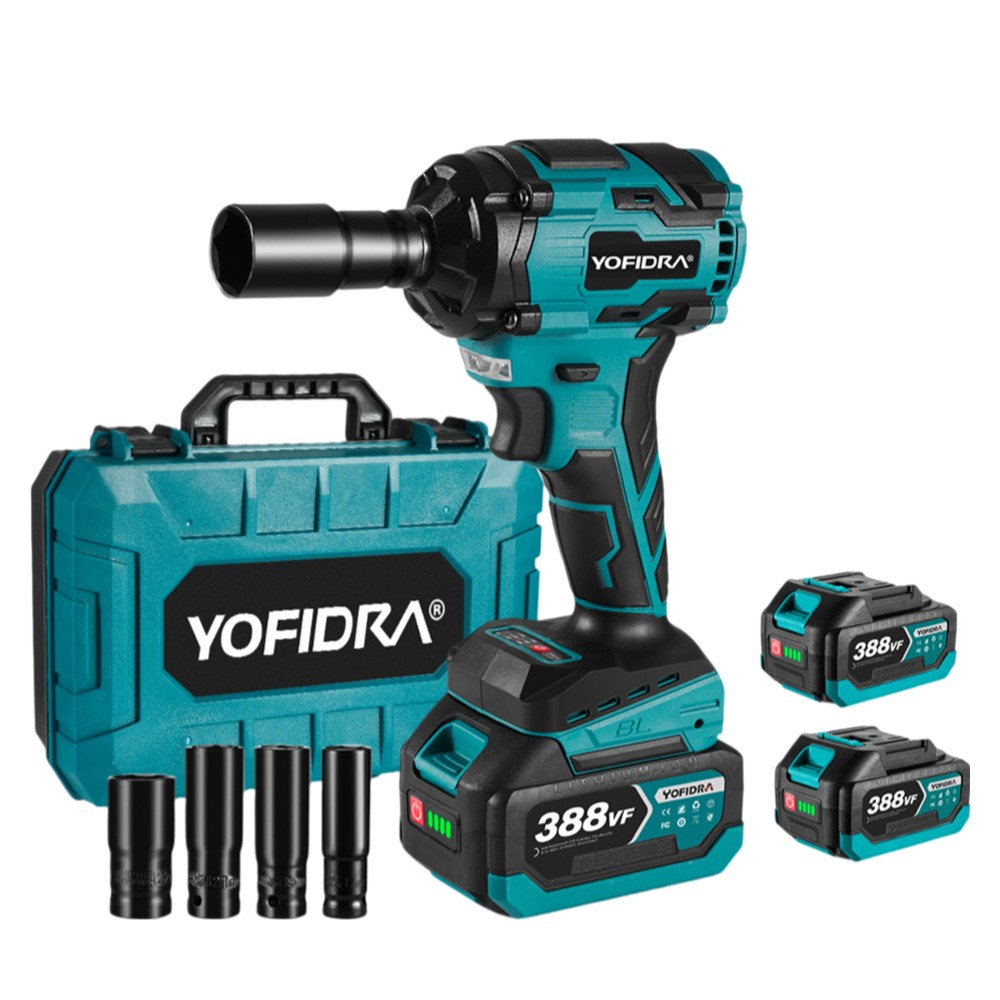
If you want one tool that does it all, the NewBeny 1/2" Cordless Impact Wrenchis a great pick. Its 1200N · m of torque is plenty of power to break loose stubborn lug nuts on cars and light trucks.
3/8-inch Drive can be effective for small fasteners and tight spaces, but may struggle with stubborn or factory-torqued lug nuts, particularly on larger vehicles. It can break them loose on a light car that's been regularly serviced, but count on it failing you exactly when you need it most: a nut that hasn't moved in three winters.
The NewBeny 3/8" right-angle wrench is not for lug nuts. It is built for tight spots. With 60 N · m of torque, it fits into engine bays where a pistol-grip tool cannot reach.
3/4-inch Drive is for serious heavy-duty work — diesel pickups, commercial trucks, equipment. If you are uncertain about needing a 3/4-inch Drive, it may be best to assess your typical use and torque requirements. The tools are large, heavy, and generally require air or high-capacity battery systems.
For heavy-duty farm equipment, the NewBeny 3/4" cordless impact wrench is the best tool. With 3300N · m of torque and a 4.0Ah battery, it has the raw power needed to loosen massive bolts.
Common Impact Wrench Torque for Lug Nuts
Here's the honest version of the torque table — not just specs, but what actually matters in practice:
|
Vehicle Type |
Lug Nut Torque |
Minimum Wrench Breakaway Torque |
|
Passenger Cars |
80 – 100 ft-lbs |
150+ ft-lbs |
|
SUVs / Light Trucks |
100 – 150 ft-lbs |
250+ ft-lbs |
|
Heavy Trucks |
150 – 200 ft-lbs |
350+ ft-lbs |
|
Performance Vehicles |
80 – 130 ft-lbs |
200+ ft-lbs |
The "minimum breakaway torque" column is what most guides don't include. But it is crucial as it indicates the torque required to loosen a nut that's been exposed to rust and thermal cycling. A nut that was torqued to 100 ft-lbs at the factory but has been sitting through three years of rust and thermal cycling may require 200–300 ft-lbs to break free. This is why a 3/8-inch wrench that's technically in spec for a Corolla still fails in the field. It is essential to have a breakaway torque rating that exceeds what you estimate you may need.
3. How to Choose Between Corded and Cordless Impact Wrenches for Lug Nuts
The market has shifted hard toward cordless over the last five years, and for good reason. However, the choice between corded and cordless is not as straightforward as it may seem.
Key Differences Between Corded and Cordless Impact Wrenches
Power Output and Performance
According to modern 20V and 18V brushless cordless impact wrenches from good brands, these models are as good as, or better than, the corded models for general automotive use. The gap has genuinely closed. Corded tools still perform better when used continuously for extended periods, such as hours of running in a shop, where battery control has become a logistical nightmare.
Portability and Convenience
This is where cordless wins decisively. Changing a tire on the side of a highway is not a situation where you want to locate a power outlet. For roadside use, emergency kits, or moving around a shop, cordless is simply the better category.
Runtime and Continuous Use
A quality 4.0Ah or 5.0Ah battery can typically complete a full tire rotation on a single charge. For high-volume tire shops doing 40+ vehicles per day, battery management — keeping two batteries cycling on the charger — becomes part of the workflow. Corded avoids this entirely.
Maintenance Requirements
Brushless cordless motors require minimal ongoing maintenance compared to brushed models. But corded models with brushed motors need occasional brush inspection. Air (pneumatic) tools require oiling, moisture traps, and air line maintenance — worthwhile for a serious shop, annoying for a home garage.
Pros and Cons of Corded Impact Wrenches
Advantages of Corded Models
- Consistent power — no degradation as a battery depletes
- Lower upfront cost in some cases
- Suited for high-volume, continuous shop use
Limitations of Corded Models
- Tethered to an outlet — limits where you can work
- Power cord management in tight spaces
- Useless for roadside or field use
Pros and Cons of Cordless Impact Wrenches
Advantages of Cordless Models
- True portability — garage, driveway, roadside, job site
- Brushless motors mean longer tool life and higher efficiency
- Battery platform compatibility across a brand's tool ecosystem
- Modern torque output rivals corded for most automotive tasks
Limitations of Cordless Models
- Battery cost adds up, especially when buying spares
- Performance dips as battery charge drops (on some models)
- Heavy with a 5.0Ah pack — can cause fatigue on extended use
Factors to Consider When Choosing
Your Typical Work Environment
Home garage with an outlet six feet away? Either works. Out in a parking lot changing a flat? Cordless only. Working at a commercial tire shop doing volume? Corded or a dedicated battery charging system.
Frequency and Duration of Use
Occasional use — a tire rotation every six months — favors cordless. Daily professional use, where the tool is operated for extended periods, favors either corded models or a high-capacity battery rotation system.
Required Torque and Power
For anything up to a 3/4-ton pickup, you can effectively manage the job with a good cordless 1/2-inch wrench. With heavy commercial trucks, you may be looking at 3/4-inch or 1-inch air-powered equipment anyway.
Budget and Cost-Effectiveness
A good, basic entry-level 1/2-inch cordless package starts at around $150 to $200 and can be used in almost all domestic and light professional applications. Low-end products first trim corners on motor quality and battery capacity. Watch out for unnaturally low prices on 1/2-inch models that claim 500-plus ft-lbs.
Recommendations for Different Users
For Home Users
A cordless 1/2-inch impact wrench usually packs a 20V brushless motor and runs on a 2.0 to 4.0Ah battery, which is the sweet spot for power. You get total portability. Plus, you can swap that same battery into your drill or saw if they are on the same platform.
Ever thought about what sockets you actually need? The 19mm and 21mm impact set covers 95% of the vehicles you will ever run into. It is a simple setup, but it works. Is it worth the investment? If you do not like rusty lug nuts with a tire iron, then absolutely.
For Professional Mechanics
A 1/2-inch mid-torque brushless cordless wrench as the daily driver, supplemented by a 1/2-inch high-torque model for stubborn or heavy-duty work. Battery platforms matter here — standardizing on one brand's ecosystem (so batteries share across all cordless tools) is a real cost and workflow advantage. For a high-volume tire shop, consider implementing a dedicated charging station to manage multiple batteries, ensuring consistent performance during peak hours. If you're working on commercial trucks regularly, a 3/4-inch air wrench is worth the compressor investment.
4. How to Use an Impact Wrench on Lug Nuts
Knowing the right tool is half the battle. Using it correctly — without damaging threads, wheels, or yourself — is the other half.
Step 1: Gather Necessary Tools and Safety Equipment
Before you start, ensure you have the following tools and safety equipment ready:
- Impact wrench, charged and ready
- Correct impact-rated socket size for your vehicle
- Torque wrench
- Safety glasses and work gloves
- Vehicle owner's manual or a reliable torque spec reference
Step 2: Prepare Your Vehicle
Park on a flat, stable surface. Apply the parking brake. For corded tools, run your extension cord clear of where you'll be working so it doesn't become a trip hazard.
Step 3: Remove Lug Nut Covers (If Applicable)
Many vehicles — especially trucks and some SUVs — use decorative covers over the actual lug nuts. These are usually plastic caps that pry off with a flathead screwdriver. Avoid attempting to place the socket over the decorative covers.
Step 4: Loosen Lug Nuts Before Lifting the Vehicle (Optional but Recommended)
With the tire still on the ground, do one quick pass with the impact wrench to break the initial torque on each lug nut. This allows you to use the friction between the wheel and the ground to prevent the wheel from spinning, making it easier to loosen the nuts. While cracking the lug nuts loose, ensure the vehicle is stable and securely supported to prevent accidents. It’s much easier than trying to fight the wheel's rotation once it’s in the air.
Step 5: Removing the Lug Nuts
Lift the vehicle using a proper floor jack and support it on jack stands before getting underneath or removing wheels. Once the wheel is off the ground, use the impact wrench to run each nut off completely. Keep them somewhere they won't roll away — a magnetic tray is worth the two dollars it costs.
Step 6: Removing the Wheel
Pull the wheel straight off the hub. If it's stuck, a firm kick with the heel of your boot on the inside of the tire usually breaks it free. Don't pry against the rotor or caliper.
Step 7: Installing the Wheel and Lug Nuts
Mount the wheel, and hand-thread all lug nuts before using the impact wrench. This is the step people skip that causes cross-threading. Feel each nut thread on smoothly with your fingers before picking up the tool. Use the impact wrench to run them down — but not to the final torque. Stop when the nut is snug, not cranked.
Step 8: Final Torque Tightening
Lower the vehicle so the tire contacts the ground (full weight not necessary, just contact to prevent wheel rotation). Use a calibrated torque wrench to tighten each lug nut to the manufacturer's spec, working in a star pattern — not circular. The star pattern equalizes clamping force across the hub evenly.
Step 9: Check Your Work
After driving 25–50 miles, re-check torque. Wheels can settle slightly after initial installation, particularly if the hub or wheel mating surfaces weren't perfectly clean. This re-check is standard practice at any shop that takes liability seriously.
Safety Tips Worth Actually Following
- Never use chrome sockets with an impact wrench. Impact-rated (black) sockets only.
- Don't rely on the impact wrench for final torque. The tool can't tell you when you've hit 100 ft-lbs. Your torque wrench can.
- Check the jack stand placement before getting a wheel off. The jack is for lifting. The stands are for safety.
- Re-torque after 50 miles on any fresh wheel installation — it takes 30 seconds and has saved a lot of wheels.
5. Conclusion
The straight answer: for most passenger cars, a 1/2-inch drive cordless impact wrench with a 19mm impact socket handles the job comfortably. Add a 21mm socket if you own a truck. Make sure your wrench has a breakaway torque of at least 150–200 ft-lbs above your vehicle's lug nut spec, because seized nuts don't read specification sheets.
What separates a competent setup from a frustrating one isn't usually the headline torque number on the box. It's the combination of the right socket size, a tool with genuine breakaway power (not just rated max torque), and the discipline to finish every job with a torque wrench. The impact wrench does the heavy lifting. The torque wrench gives you the number you can trust.
For a reliable cordless impact wrench that covers this range, consider exploring the options available in Newbeny Tool's impact wrench collection.
6. FAQs
Which impact wrench size fits a standard car?
For most sedans or small SUVs, a 1/2-inch drive is the sweet spot. It is the tool you will see in almost every garage because it just works for lug nuts. You will likely need a 19mm socket, though some cars take a 17mm or 21mm. Even if your manual says to tighten things to 80 ft-lbs, get a wrench that hits at least 250 ft-lbs. Why? Because rust happens. A stuck nut needs way more power to break loose than it took to put on.
When should I change torque settings for different vehicles?
Always check the sticker inside your driver-side door first, as it typically provides the manufacturer's recommended torque specifications for your vehicle. That is the gold standard. If you cannot find it, small cars usually sit around 80 to 100 ft-lbs. Once you move up to mid-size SUVs, you are looking at 100 to 130 ft-lbs. Big trucks? Those go higher, maybe 135 to 165 ft-lbs. Some fancy sports cars even have different numbers for the front and back wheels. If you are working on a massive commercial rig, you are in a totally different league—often starting at 200 ft-lbs. Stick to the official specs.
Gas or electric wrench for the heavy jobs?
In practice, gas-powered tools are rarely used for automotive wheel work. It is usually a fight between air tools and battery power. For heavy-duty trucks, those high-torque cordless electric wrenches are surprisingly great now. They handle most big jobs without a cord. But, if you are in a shop working on 18-wheelers all day, a pneumatic (air) 1-inch wrench is still king. It stays strong all shift long, while batteries might start to lag under that kind of constant stress.
How do I get the socket onto the wrench?
It is pretty simple: line up the square tip of the wrench with the square hole in your socket. Push it on hard. You should feel or hear a click. Most of these tools use a little spring-loaded ball called a detent pin to grab the socket. For extra safety—especially on big jobs—some people use a rubber ring or a locking pin to make sure it stays put. Give it a good pull before you start. You definitely do not want a heavy metal socket flying off at high speeds.
What makes an impact wrench different from an impact driver?
They look similar and both hammer as they spin, but they do different work. An impact driver works as a powered screwdriver for wood or small bolts; it uses a 1/4-inch hex hole for bits. An impact wrench is a beast made for heavy nuts. It has a square drive (usually 1/2-inch) and way more muscle. Sure, you could use an adapter to try to pull a lug nut with a driver, but you might break the tool. If you are swapping tires, use the wrench.